Introduction
Your caseworkers are drowning in spreadsheets. A referral comes in from a partner shelter, a client's information lives in three different files, and nobody's totally sure who followed up last. Sound familiar?
You're not alone. 49% of nonprofits still record client data in spreadsheets, and 22% rely on paper files, according to TechSoup's global survey of nearly 12,000 civil-society organizations.
That gap shows up every day as duplicate intake forms, missed follow-ups, and reports pieced together at the last minute.
Naturally, enterprise nonprofit CRM platforms come up in every conversation about fixing it. But these platforms often bundle multiple modules under complex terminology that stops nonprofit leaders before they even get to pricing.
This guide breaks down what enterprise nonprofit CRM platforms with case management modules actually do, where they require significant investment for smaller teams, and how purpose-built alternatives like CharityTracker compare.
Key Takeaways
- Enterprise nonprofit CRM platforms extend their core architecture for intake, referrals, and case notes
- Digitizing case management can save thousands of staff hours yearly, per customer data
- That flexibility adds configuration complexity and costs that strain smaller budgets
- Purpose-built tools like CharityTracker cut setup time and cost for simpler needs
What Are Enterprise Nonprofit CRM Platforms with Case Management?
Enterprise nonprofit CRM platforms are suites of applications built for nonprofits, covering donor and constituent relationship management, fundraising, grants management, program and case management, and reporting. They function less as a single product than as a collection of tools on one integrated platform.
The case management module specifically extends the platform's program management layer. It adds structure for participant intake, referral tracking, service delivery, and case notes on top of the platform's existing constituent management framework.
Foundational vs. Unified Architecture: Understanding CRM Platform Generations
This is where most confusion starts.
- Foundational open-source CRM data models are the earlier generation of nonprofit CRM architecture, built primarily for donor and constituent management. They run as layered packages on top of the core platform.
- Modern unified nonprofit CRM suites are the newer generation, built natively for program delivery, case management, and fundraising with a more contemporary architecture.
Both paths still require licensing, setup time, and in most cases a certified implementation partner. Migration guides for organizations moving between these generations explicitly recommend a full "assess and plan" process. It isn't a one-click upgrade. The right choice depends on how complex your programs are, not just which one costs less upfront.
Core Objectives Every Case Management Process Should Meet
Before evaluating any platform, measure it against the standards that actually define good case management. The National Association of Social Workers outlines these principles:
- Person-centered practice: clients are engaged in decisions about their own services
- Cross-agency collaboration: interdisciplinary coordination across organizations
- Client advocacy: services tailored to individual needs and goals
- Confidentiality: protected records, valid consent, and limited disclosure
- Cultural competence: linguistically and culturally appropriate service delivery
Any platform evaluated should be judged against this list first. Features are secondary.
Key Features of Enterprise Nonprofit CRM Case Management
Enterprise nonprofit CRM platforms cover a lot of ground once configured. Here's what's actually included:
- Inbound referrals and intake: Simplifies onboarding for clients referred from partner agencies, such as a shelter receiving referrals from a local hospital
- Dynamic assessments via guided intake flow builders: Guided, configurable intake flows that adjust based on program type, useful for distinguishing a counseling intake from a housing assessment
- Case tracking and care plans: Lets case managers monitor progress against individualized goals and templates
- Interaction summaries and complaint tracking: Documents client meetings and manages service-related incidents for accountability
- Secure external collaboration portals: A secure external space where volunteers, donors, and partner agencies can collaborate digitally
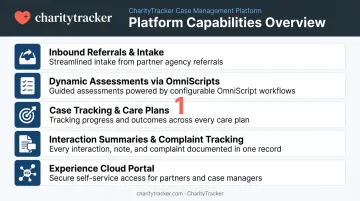
Platform documentation for these guided flows describes them as interactions that must be built and maintained by someone comfortable with the platform's tools.
Worth noting: For teams without dedicated technical staff, the configuration requirements of enterprise CRM platforms represent a real time and resource investment before the full feature set is accessible.
Benefits and Real-World Impact of Digital Case Management
Moving off paper and spreadsheets isn't just a tidiness upgrade. The efficiency gains are measurable, as these results show:
- Year Up replaced a spreadsheet-heavy internship-matching process with a digital system, resulting in a significant increase in staff efficiency and thousands of hours saved annually, according to the organization.
- A Michigan child-welfare nonprofit centralized child, family, and caseworker records digitally, cutting foster-home licensing time from 13 months to 6 months, according to the organization.
- Nathaniel R., an office clerk at a First Call for Help agency, cut paperwork time "in half, at least" after switching intake and documentation to CharityTracker.
These are individual results, not sector-wide averages, but they show what centralized case data can achieve. Grant compliance gets easier too: when client data lives in one system instead of scattered files, funder reports pull together faster and audits go smoother.
That said, these gains aren't exclusive to any single platform. The lesson holds across systems: centralizing case data reduces administrative drag, regardless of which system you choose.
Challenges and Limitations to Consider
The flexibility of enterprise nonprofit CRM platforms is real. So is the cost of unlocking it.
Configuration complexity tops the list. Organizations running multiple programs typically need a paid implementation partner to build out guided intake flows, referral workflows, and reporting structures. This isn't optional for most teams — setup documentation for these platforms targets experienced administrators and consultants, not general nonprofit staff.
Total cost of ownership goes well beyond licensing. Some enterprise vendors offer donated or discounted license programs for eligible nonprofits, typically covering a limited number of seats. However, these programs rarely cover:
- Data migration and cleanup
- Custom configuration and integrations
- Staff training and change management
- Ongoing administration
Learning curve and maintenance compound the problem. Guided intake flows, external portals, and custom workflows all need continuous upkeep, meaning the cost doesn't stop after go-live.
A Purpose-Built Alternative Worth Considering
This is exactly the gap CharityTracker was built to fill. Instead of a platform that requires custom configuration to do basic case management, CharityTracker ships with the workflows nonprofits actually need:
- Digital and remote/kiosk intake, letting clients complete forms on their own time
- Barcode scanning for fast client check-in, particularly useful in shelter settings
- A built-in inter-agency referral network for real-time coordination across partner organizations
- Plans starting at $60/month per user, including API access and deeper assessment tools

Affordability doesn't mean lightweight, either. CharityTracker is used by national organizations like The Salvation Army and Boys & Girls Clubs of America, proof that a faster, simpler setup can still hold up at scale.
Choosing the Right Case Management Solution for Your Nonprofit
Before committing to any platform, run it through a practical checklist:
| Question | Why it matters |
|---|---|
| Is it nonprofit-specific? | General CRMs aren't built for outcome tracking or funder reporting |
| Can it scale with your team? | Growth shouldn't require a full re-platform |
| Does customization need IT support? | Determines your real ongoing cost |
| What's the true total cost of ownership? | Include implementation, training, and admin time, not just licensing |
These answers point to one core principle: match complexity to actual need. Single-program or smaller nonprofits are often better served by a lightweight, ready-to-use system like CharityTracker. Multi-program organizations with complex compliance requirements, such as HUD/HMIS reporting across several funding streams, may genuinely need the deeper customization enterprise platforms provide.
Implementation speed matters more than most teams expect. A platform that takes six months to configure delays every report, referral, and grant application in the meantime.
CharityTracker's approach centers on guided onboarding, designed to get organizations tracking and reporting in minutes rather than months. That speed matters for teams that need to serve clients now, not next quarter.
Frequently Asked Questions
Can enterprise nonprofit CRM platforms be used for case management?
Enterprise nonprofit CRM platforms can be configured for case management through purpose-built modules layered on their core architecture. They work best for organizations with single or relatively simple programs; complex, multi-program needs often require heavier configuration.
What is the difference between foundational and unified nonprofit CRM architectures?
Foundational open-source CRM data models are the earlier generation of nonprofit CRM architecture, built primarily for donor and constituent management, running as layered packages on the core platform. Modern unified nonprofit CRM suites are the newer generation, built natively for program delivery, case management, and fundraising with a more contemporary architecture.
Do I need specialist expertise to implement enterprise nonprofit CRM platforms?
Most organizations benefit from a certified implementation partner given the setup complexity involved. Smaller nonprofits without technical staff often prefer faster-to-deploy, purpose-built platforms instead.
Are enterprise nonprofit CRM platforms free for nonprofits?
Some vendors offer donated or discounted license programs covering a limited number of seats for eligible nonprofits. Implementation, customization, and consulting costs still apply on top of any donated licenses.
What size organization do enterprise nonprofit CRM platforms suit best?
They fit organizations with dedicated technical resources or a consultant budget to manage setup and maintenance. Smaller teams without that capacity often prefer purpose-built platforms designed for quick deployment without heavy configuration, such as CharityTracker.
How is nonprofit case management software different from a general CRM?
Case management software is purpose-built for tracking client outcomes, service delivery, and inter-agency referrals. General CRMs are designed around sales pipelines, not client service workflows.