Yet many nonprofits and agencies still struggle here. Paper forms get lost. The same client re-enters their story at three different intake desks because agencies don't share data. Risk factors slip through because the questions weren't there to catch them.
This guide breaks down what intake and assessment forms actually are, how they differ across case management models, the essential sections every form needs, the six-step process behind a solid intake, and why more organizations are ditching paper for digital intake tools.
Key Takeaways
- Intake forms capture client data; assessment forms evaluate needs, risk, and eligibility to build the case file
- Case management models (comprehensive, clinical, brokerage, crisis/disaster) shape form depth, but core fields stay consistent
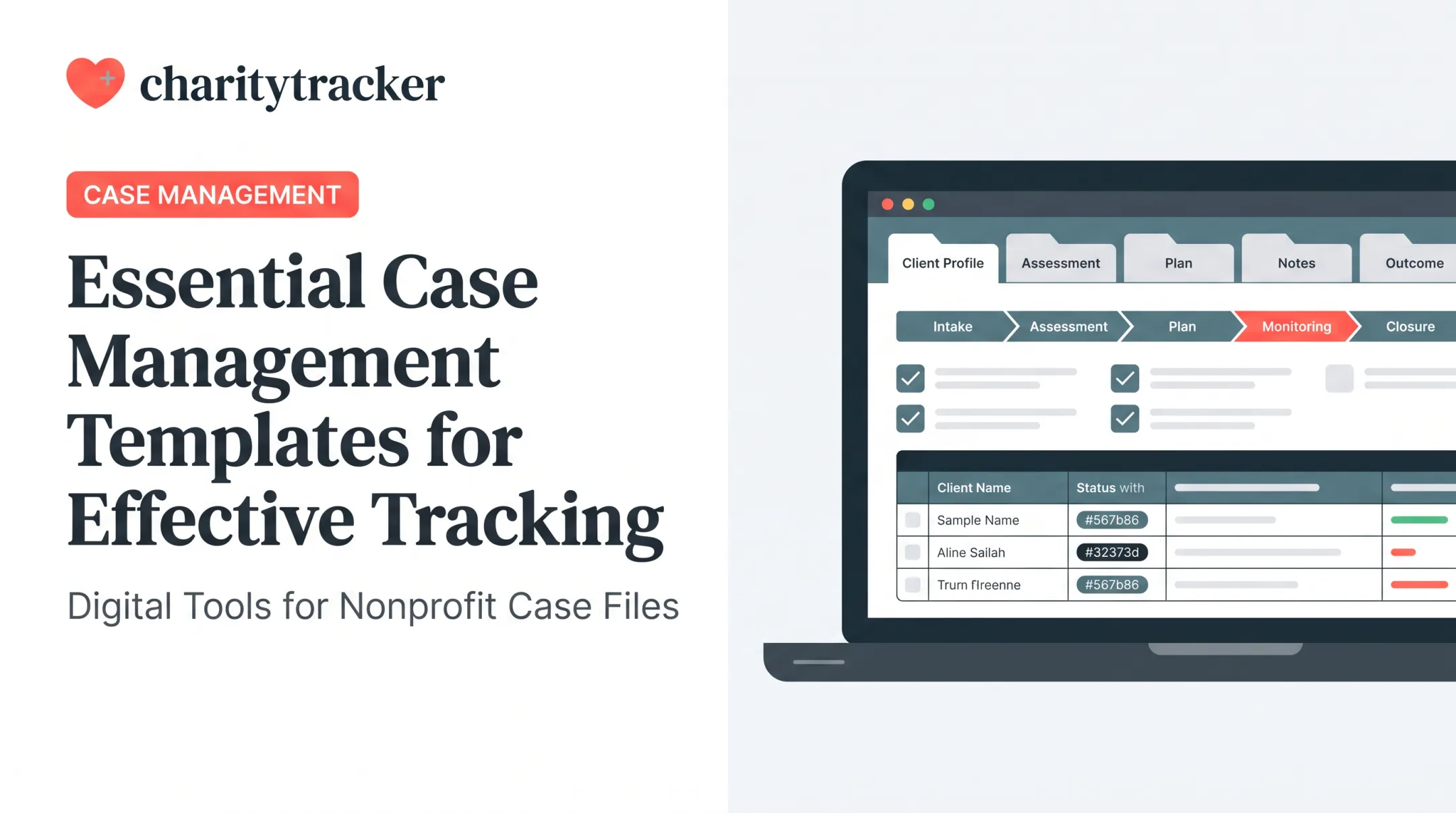
- A complete process spans six steps: intake, assessment, planning, implementation, monitoring, and closure
- Digital intake tools cut paperwork time and duplicate service delivery while strengthening compliance
What Are Case Management Intake and Assessment Forms?
A case management intake form is the first document a client completes when entering a program. It captures demographic details, contact information, and how the client found the organization in the first place. It's the entry point: quick, factual, and focused on connecting someone to help.
An assessment form goes further. Once basic intake is complete, caseworkers use assessment tools to evaluate needs, risk level, eligibility for specific programs, and initial goals. The two documents work in sequence: intake opens the door, assessment maps out what's behind it. Platforms like CharityTracker keep this handoff seamless, letting caseworkers build customizable needs assessments directly from client intake data without re-entering information.
Why Standardization Matters
Standardized forms create a consistent, auditable record that:
- Supports accurate funder and grant reporting
- Keeps compliance documentation defensible during audits
- Preserves continuity of care when staff turn over or clients transfer between programs
Without a standard template, every caseworker builds their own version of "complete." That inconsistency shows up the moment a funder asks for outcome data or a new hire inherits an open case file.
Why These Forms Matter Across Multiple Programs and Agencies
Paper-based or inconsistent intake creates data silos. When a client visits a food pantry on Monday and a housing program on Wednesday, and neither system talks to the other, agencies risk duplicate service delivery and missed risk factors that a shared record would have flagged.
This is also a resource problem. Nonprofits already carry heavy administrative loads. Grant-related paperwork alone averages 27.45 hours per application and 20.48 hours per required report, according to Project Streamline's national research on nonprofit administrative burden. Every hour spent re-entering intake data across disconnected systems is an hour not spent on direct service.
Centralizing intake through a shared platform changes that math. One CharityTracker user, a First Call for Help representative, put it plainly:
"The networking with other agencies has definitely enabled us to ensure we do not duplicate services and helped increase capacity."
Coordinated intake data helps agencies:
- Spot when a client is already receiving assistance elsewhere
- Reduce redundant financial or in-kind aid payouts
- Free up staff time previously lost to manual cross-checking

Types of Case Management (and How Forms Differ by Model)
Not every intake form asks the same depth of question, because not every case management model needs the same depth of information. SAMHSA's framework for case management distinguishes models by assessment breadth and service intensity.
| Model | Assessment Depth | Typical Focus |
|---|---|---|
| Brokerage/Coordination | Brief, resource-focused | Immediate needs, quick referral out |
| Comprehensive/Intensive | Broad, biopsychosocial | Multiple integrated services, crisis stabilization |
| Clinical/Rehabilitation | Broad, life-area goals | Direct therapeutic services, skills teaching |
| Crisis/Disaster Response | Rapid, needs-driven | Immediate safety, long-term recovery planning |
A disaster relief intake, for instance, needs to move fast: shelter status, immediate safety, and household needs come first, with less emphasis on long-term history. A youth program or healthcare intake, by contrast, often requires detailed educational or medical background before services even begin.
Food banks, faith-based ministries, and youth-serving organizations all shape their forms around what their program actually delivers. Despite these differences, every model shares the same core fields:
- Identity and contact information
- Presenting need
- Goals and desired outcomes That overlap is exactly why a standardized template — customizable at the edges — still works across sectors.
Essential Sections Every Intake and Assessment Form Should Include
A well-built form organizes information into distinct domains rather than cramming everything into one long questionnaire. Each section serves a different purpose in the case file.
Client Demographics & Contact Information
This section covers full name, date of birth, phone and email, emergency contacts, and household composition. Verifying accuracy here upfront prevents communication breakdowns later: a wrong phone number or an outdated address can derail follow-up before it starts.
Referral Source & Presenting Need
Beyond contact details, documenting who referred the client, and why, shapes initial priorities. It also enables inter-agency coordination: when referral source data is logged consistently, agencies can spot overlapping requests before they turn into duplicate assistance.
Psychosocial, Health & Household History
Following referral details, this section captures income, employment, housing status, and relevant health history. These fields give caseworkers the full picture needed to match a client with the right combination of services, not just the first one available.
Risk Assessment & Needs Screening
With household history captured, the form turns to risk detection, where structured, validated screening questions matter more than open-ended ones. A well-designed 2-item food insecurity screen, for example, achieved 97% sensitivity and 83% specificity against the USDA's full 18-item reference tool. The finding comes from a study of over 30,000 low-income families, according to research published in Pediatrics. That's strong evidence that short, validated screens can identify needs quickly and accurately.
Forms should score and document responses on:
- Safety concerns
- Housing instability
- Food insecurity
Eligibility, Consent & Signature
After documenting risks, the form closes with consent-to-share-information language, program eligibility checkboxes, and a signature. Digital signature capture eliminates paper entirely here — CharityTracker's platform, for example, stores signed consent forms and Release of Information documents directly in the client's digital record, so nothing gets misplaced in a filing cabinet.
Steps to Conduct an Effective Case Management Intake and Assessment
A complete intake-to-closure process generally follows six steps, broadly aligned with NASW's core functions of social work case management.
- Intake & Screening — Initial contact and eligibility screening confirm the client qualifies for services before deeper work begins.
- Assessment — Caseworkers conduct an in-depth evaluation of needs, risks, and strengths using a customizable assessment form.
- Planning — Assessment findings translate into a documented service plan with specific, measurable goals and timelines.
- Implementation — Staff deliver services, make referrals, and log case notes as work progresses.
- Monitoring & Follow-Up — Caseworkers track progress against goals through periodic reassessment and updated case notes.
- Evaluation & Case Closure — Caseworkers document outcomes, close the case file, and feed the data into funder or grant reporting.

Each step depends on the one before it.
Skip a thorough assessment, and the service plan built on top of it won't fit the client's actual situation.
CharityTracker's assessment forms link directly to service plans and case notes, keeping every step connected.
Digital Intake & Assessment: Why Organizations Are Moving Away From Paper
Paper intake slows everything down. Transcription errors creep in when handwritten forms get re-typed into a database. Sharing data across programs or agencies means faxing, scanning, or physically mailing files, hardly efficient when a client needs help now.
The time cost is real and measurable. North Carolina child welfare caseworkers spent 2.8 hours per month, or 1.7% of their work time, just completing paper-based day sheets, according to a state child welfare workload study. Multiply that across a caseload, and it's hours that could go toward direct client work instead.
Digital forms solve this through:
- Auto-populated client records that pull existing data instead of asking clients to repeat themselves
- Conditional logic that adapts questions based on prior answers
- Instant sharing across caseworkers and partner agencies
CharityTracker's Remote Intake and Kiosk tools let clients complete their own digital intake from anywhere, before they ever sit down with a caseworker. Combined with barcode scanning for faster check-in, organizations using the platform report cutting paperwork time by at least 50%, while the shared network helps prevent duplicate assistance across agencies.
None of this works without security. CharityTracker stays HIPAA-aligned, using encrypted storage and role-based access controls that limit who can see what, protecting client information without slowing down the staff who need it.

Frequently Asked Questions
What are the types of case management?
The main models are comprehensive/intensive, clinical or medical, brokerage/coordination, and crisis or disaster response. The right type depends on client complexity and the program's service goals.
What are the steps of case management?
The six core steps are intake and screening, assessment, planning, implementation, monitoring, and case closure. Each step builds directly on the information gathered in the one before it.
What is the difference between an intake form and an assessment form?
Intake forms gather initial identifying and contact information when a client first enters a program. Assessment forms go deeper, evaluating needs, risk level, and program eligibility.
What information is required on a case management intake form?
Most forms cover demographics, referral source, presenting need, risk screening questions, and a consent/signature section. The exact depth varies by program type and sector.
Can intake and assessment forms be completed remotely or digitally?
Yes. Platforms like CharityTracker offer digital and kiosk-based intake tools that let clients self-complete forms before their first appointment, speeding up processing and reducing transcription errors.
How long should case management intake and assessment records be retained?
Requirements vary by jurisdiction and funder — some rules require three years, others five years post-closure. Confirm specific state and funder requirements before setting a retention policy.