Introduction
Picture a mother of three walking into a housing agency on Monday, a food pantry on Tuesday, and a mental health provider on Thursday.
Each intake worker asks the same questions: her income, her housing history, her children's names, her trauma. None of them can see what the others already know.
This isn't a rare scenario. The GAO identified 26 federal homelessness programs spread across 8 agencies in FY2010 alone, obligating roughly $2.8 billion with documented fragmentation and overlap between programs (GAO, Homelessness: Fragmentation and Overlap).
When systems don't talk to each other, families do the talking instead, over and over.
This post breaks down what collaborative case management actually means, walks through its process stage by stage, and shows how platforms like CharityTracker turn cross-agency coordination from a theory into daily practice.
Key Takeaways
- Collaborative case management unites agencies around one client's shared goals
- It cuts duplicate services, speeds referrals, and boosts accountability
- Six stages guide it: intake, assessment, planning, coordination, monitoring, evaluation
- CharityTracker gives nonprofits, agencies, and faith-based groups a secure, shared workspace
What Is Collaborative Case Management?
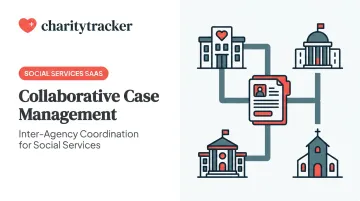
Collaborative case management is a coordinated approach where multiple agencies and providers share information and align their interventions around a client's complete set of needs. Instead of each organization chasing its own isolated goal, everyone works from the same picture.
Traditional case management works differently. Each agency tracks its own outcomes, keeps its own files, and rarely knows what another provider already tried.
A housing counselor might not know a client is also seeing a substance use counselor. A food pantry has no idea the same family got emergency rent assistance last month from a church down the street.
This matters because needs rarely show up in isolation. The CDC's 2026 BRFSS analysis of over 324,000 adults found that 66.3% had at least one chronic disease and 59.4% reported at least one adverse social determinant of health. Another 11.1% faced five or more adverse indicators simultaneously.

A family dealing with diabetes and food insecurity needs a clinic and a pantry working together, not two separate case files that never cross paths.
Who's at the Table
Collaborative models typically involve:
- The client or family, whose goals drive the plan
- Case managers coordinating across organizations
- Referral agencies and specialty providers
- Funders who require outcome reporting
- Community partners filling specific gaps (housing, food, transportation)
Born From a Real Crisis, Not a Whiteboard
CharityTracker's own origin makes the case better than any statistic. In 2026, a group of community leaders in Florence, Alabama, were coordinating Hurricane Katrina long-term recovery efforts when they hit a wall. As one early user, Patricia C., a Business Administrator involved in that recovery work, put it:
"We realized during Hurricane Katrina long term recovery efforts that duplication of services could not be easily identified... We worked with Simon Solutions reps in developing this program, relaying what we needed to be able to see in a shared environment."
Agencies were handing out aid to the same families without knowing it. There was no shared view of who had already received help. That gap, discovered in the middle of a disaster response, is the exact problem collaborative case management software was built to solve.
Why It Matters: The Cost of Siloed Case Management
When agencies don't share data, families pay the price first. A parent fleeing domestic violence might retell her trauma history five times in five weeks, once for every intake form at every agency door. Each retelling delays the help she actually needs.
Repetition carries a real cost. According to the Urban Institute, benefit applicants often wait in long lines, hand over the same documents to multiple caseworkers, and make repeat visits just to keep benefits they already qualify for.
The GAO found a similar pattern in homelessness services: providers describe managing multiple federal applications and overlapping reporting requirements as burdensome and costly. No agency has yet published a single national dollar figure for that waste.
The bigger issue is what happens when nobody has the full picture:
- Case managers make decisions with incomplete information
- Agencies spend resources twice on the same need while other needs go unmet
- Trust erodes, families disengage, and cycles of crisis or poverty repeat themselves
Without one coordinated view, no single person is actually responsible for the outcome. Everyone owns a piece of the case; nobody owns the whole.
The Collaborative Case Management Process: Key Stages
Collaborative case management follows a defined arc, drawn from standards published by the Case Management Society of America (CMSA) and the National Association of Social Workers (NASW). Here's how each stage works when multiple agencies are involved.
Intake
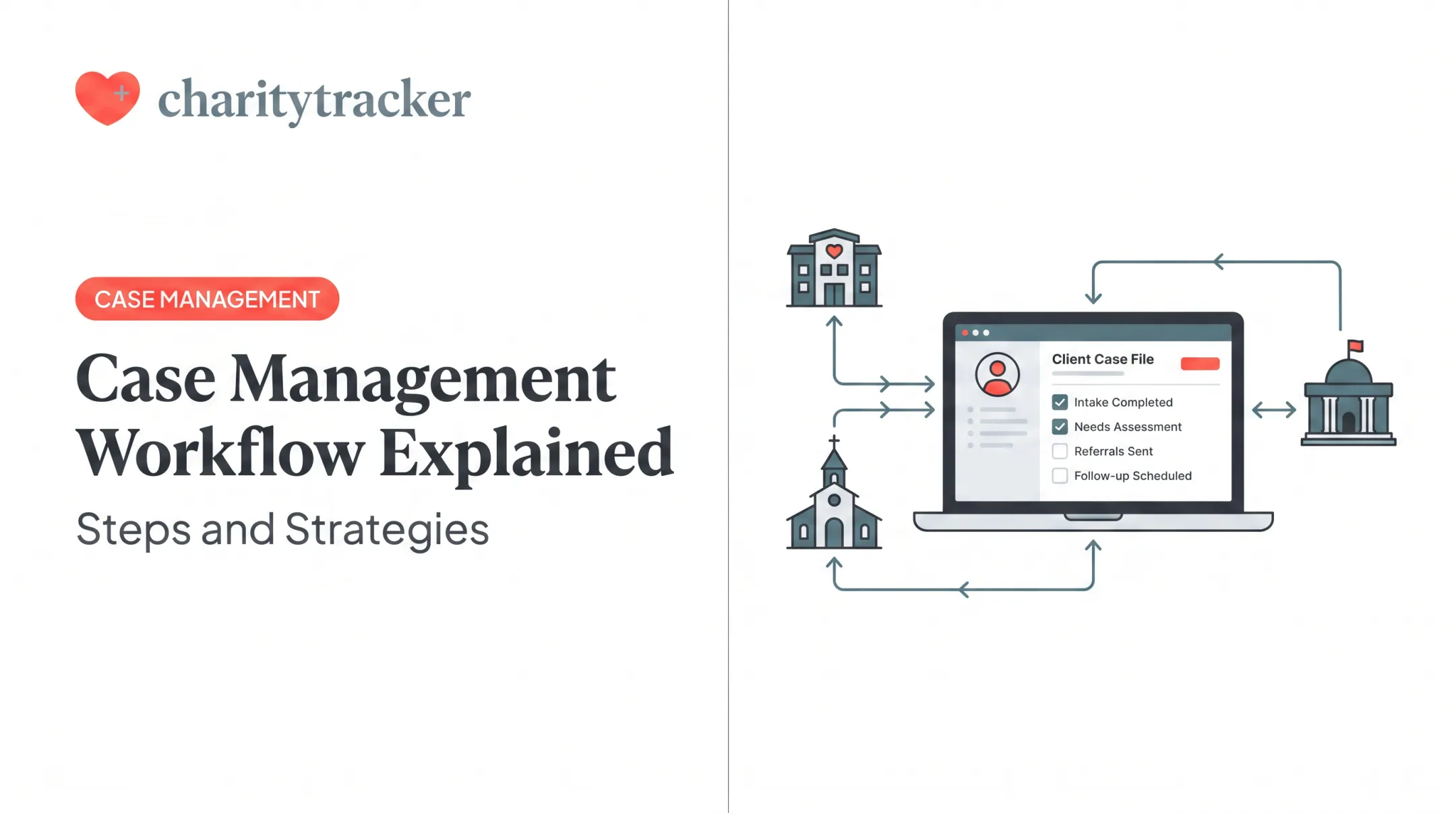
Intake gathers demographic and needs information once, ideally through a shared digital system. Instead of five agencies re-interviewing the same client, one intake record becomes visible to every authorized partner from the start.
Needs Assessment
Stakeholders jointly identify the client's full range of needs, not just the piece relevant to their own program. NASW's practice standards frame this as ongoing information-gathering tied directly to the client's strengths, challenges, and stated goals, done collaboratively rather than department by department.
Service/Care Planning
This stage produces one coordinated plan with clearly assigned roles. Who handles housing? Who manages the medical follow-up? Who tracks the school enrollment paperwork? Everyone knows their part and the timeline.
Coordination & Implementation
Providers execute the plan while sharing updates, referrals, and case notes in real time, often through a connected platform like CharityTracker's inter-agency referral network. This is where most siloed systems break, because without shared visibility, coordination becomes a guessing game.
Monitoring & Follow-Up
Case managers track progress across every agency involved, not just their own piece, adjusting the plan as circumstances change. If a client loses stable housing mid-plan, for example, every partner sees the update immediately and can pivot their piece of the plan right away.
Evaluation & Case Closure
Case managers measure outcomes against the goals set at intake and document findings before the case transitions to another provider or closes entirely, so the next case manager (if there is one) inherits real history, not a blank slate.

How the Right Software Powers Seamless Collaboration
Phone calls, faxes, and spreadsheets work fine when one agency handles one client. Add a second or third agency, and manual coordination collapses under its own weight. Someone forgets to call back. A fax gets lost. A spreadsheet version goes stale the moment someone else edits their copy.
Effective collaboration software needs a few non-negotiable features:
- Shared case notes visible to every authorized partner agency
- Secure messaging built into the workflow, not a separate email chain
- Real-time dashboards showing where a case actually stands
- Inter-agency referral network connecting partners directly
Preventing Duplicate Assistance in Real Time
CharityTracker was built around exactly this need. Its inter-agency network lets nonprofits, faith-based ministries, and government agencies refer clients and view shared case history without waiting on a phone tag chain.
As Nathaniel R., an Office Clerk and First Call for Help Representative, described it: "The networking with other agencies has definitely enabled us to ensure we do not duplicate services and helped increase capacity."
That kind of visibility is the direct answer to the Katrina-era problem that started the whole platform: agencies simply couldn't tell if a family had already received help elsewhere.
Security Can't Be an Afterthought
Once multiple organizations access shared client data, security becomes the foundation everything else stands on. CharityTracker maintains HIPAA-aligned protections designed to meet federal, state, and local confidentiality requirements, so agencies can collaborate without exposing sensitive records to the wrong hands.
Less Paperwork, Stronger Reporting
Beyond coordination, centralized platforms simplify the administrative side too. One CharityTracker user reported cutting paperwork time by roughly half after switching to a shared system.
Organizations using the Pro Plan ($60/month) get built-in API access and assessment tools, making funder and grant reporting far less painful than compiling data from five disconnected spreadsheets.
Best Practices for Building a Collaborative Case Management Culture
Software alone doesn't build collaboration. The agencies using it have to agree on how they'll work together first.
- Set shared goals before rollout: partner agencies should agree on what "success" looks like for a client before anyone touches the software.
- Draft data-sharing agreements early: define what gets shared, with whom, and under what conditions, before the first case gets entered.
- Establish communication protocols: decide who reaches out first when a case stalls, and how updates get logged so nothing falls through the cracks.
- Train case workers on habits, not just software: transparent communication and trust across organizations matter more than knowing which button to click.
- Measure shared outcomes continuously: unified reporting proves impact to funders and boards, and it flags when the collaboration itself needs adjusting.

Getting this right takes intentional groundwork. But agencies that skip it often end up with expensive software and the same old silos underneath.
Frequently Asked Questions
What is the purpose of collaborative case management?
Its purpose is to align multiple agencies and providers around a client's full range of needs, reducing duplicated services and speeding up how quickly help actually reaches families. It replaces isolated efforts with one shared plan.
What are the four types of case management?
SAMHSA's framework identifies four models:
- Broker/generalist: connects clients to resources
- Strengths-based: builds on client-defined goals
- Assertive community treatment: unifies crisis and treatment services
- Clinical/rehabilitation: integrates therapeutic and skills-based support
What are the 5 principles of case management?
There's no single official list, but core themes across NASW and CMSA standards include client-centeredness, advocacy, interorganizational collaboration, accountability, and ethical, confidential practice.
How is collaborative case management different from traditional case management?
Traditional case management keeps each agency's records and goals separate, with little visibility into what other providers are doing. Collaborative case management shares data and coordinates interventions across agencies around one unified plan.
What software features support collaborative case management?
Look for shared case notes, secure messaging, real-time dashboards, and an inter-agency referral network. Compliant data-sharing tools, like CharityTracker's HIPAA-aligned platform, are essential once multiple organizations touch the same client file.
Who benefits from collaborative case management?
Clients get faster, less repetitive service. Case workers save time on redundant paperwork. Partner agencies avoid duplicated effort, and funders get clearer, more accurate outcome data across the board.