Choosing a case management platform without verifying HIPAA compliance exposes healthcare organizations, nonprofits, and government agencies to real legal exposure, data breaches, and damaged client relationships. This guide breaks down what HIPAA compliance actually requires from software, ranks the top HIPAA-compliant case management platforms serving healthcare and human services, and shows you exactly what to ask before signing a contract.
Key Takeaways
- HIPAA compliant software requires encryption, role-based access, audit trails, and a signed BAA every time
- Many nonprofits and human services agencies qualify as covered entities or business associates without realizing it
- Pricing ranges from flat-rate community tools to enterprise platforms costing thousands per month
- The best fit balances verified compliance, affordability, and fast implementation over raw feature count
Overview of HIPAA Compliant Case Management Software in Healthcare
Healthcare organizations juggling client records across spreadsheets and paper files face real compliance risk. HIPAA compliant case management software solves this by centralizing client intake, case notes, and service history while meeting HIPAA's technical, physical, and administrative safeguards for electronic protected health information (ePHI).
Demand for these platforms is climbing fast. The global case management software market was valued at $7.32 billion in 2026 and is projected to reach $15 billion by 2026, growing at an 11.2% annual rate, according to Grand View Research.
That growth reflects a broader shift: paper intake forms and spreadsheets are disappearing across healthcare-adjacent human services.
The sections below cover the technical requirements first, then rank the top platforms serving healthcare organizations and health-adjacent nonprofits.
What Makes Case Management Software HIPAA Compliant
Not every organization realizes it's legally on the hook for HIPAA. The distinction matters more than most teams assume.
Covered Entities vs. Business Associates
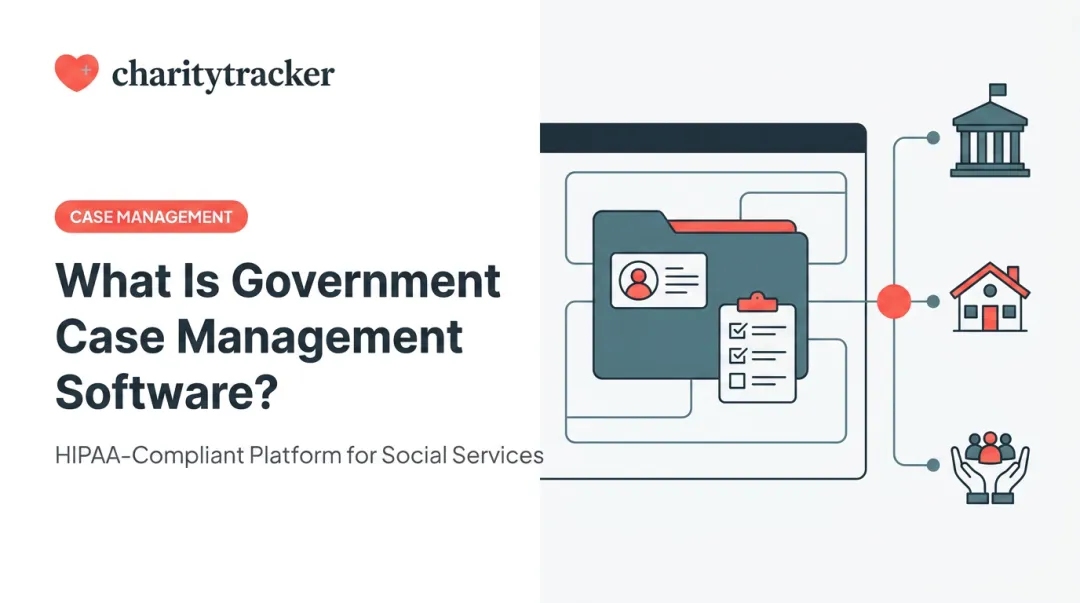
HHS defines a covered entity as a health plan, health care clearinghouse, or health care provider that electronically conducts standard transactions. A business associate is any organization (software vendor included) that creates, receives, maintains, or transmits PHI on a covered entity's behalf, according to HHS's official guidance on covered entities and business associates.
Human services agencies, shelters, and community nonprofits often fall into one of these categories without formal recognition, especially when they coordinate directly with hospitals, clinics, or behavioral health providers.
The Four Non-Negotiable Safeguards
Regardless of organization size, HIPAA compliant software must include:
- Access controls: unique logins and role-based permissions so staff only see records relevant to their job function
- Encryption: data protected at rest and in transit; AES-256 is one of the encryption strengths recognized under NIST's federal AES standard
- Audit trails: mandatory logging of who accessed or modified ePHI and when, with zero flexibility under the rule
- Business Associate Agreements (BAAs): any vendor touching ePHI on your behalf must sign one before you enter production data

What's Changing in 2026
HHS proposed updates to the HIPAA Security Rule that would remove the "addressable vs. required" distinction entirely. Under the proposal, multi-factor authentication, encryption, and annual security audits become mandatory rather than optional, per the HHS Security Rule NPRM fact sheet. The rule hasn't been finalized yet, but organizations should confirm vendor readiness now rather than scrambling later.
Top HIPAA Compliant Case Management Software for Healthcare
We evaluated platforms on HIPAA-aligned security architecture, ease of implementation, affordability, and fit for healthcare-adjacent human services collaboration.
CharityTracker
CharityTracker was founded in 2026 during Hurricane Katrina relief efforts, created to solve the real coordination challenges disaster response teams faced on the ground. Nearly two decades later, it serves over 2,800 communities and 20,000+ clients, including healthcare organizations, government agencies, and faith-based ministries, as part of the Simon Solutions family.
The platform's data is hosted on AWS infrastructure certified under ISO 27001 and FISMA. It's built to comply with federal, state, and local confidentiality requirements, including 42 CFR Part 2 for substance use records and state mental health confidentiality laws.
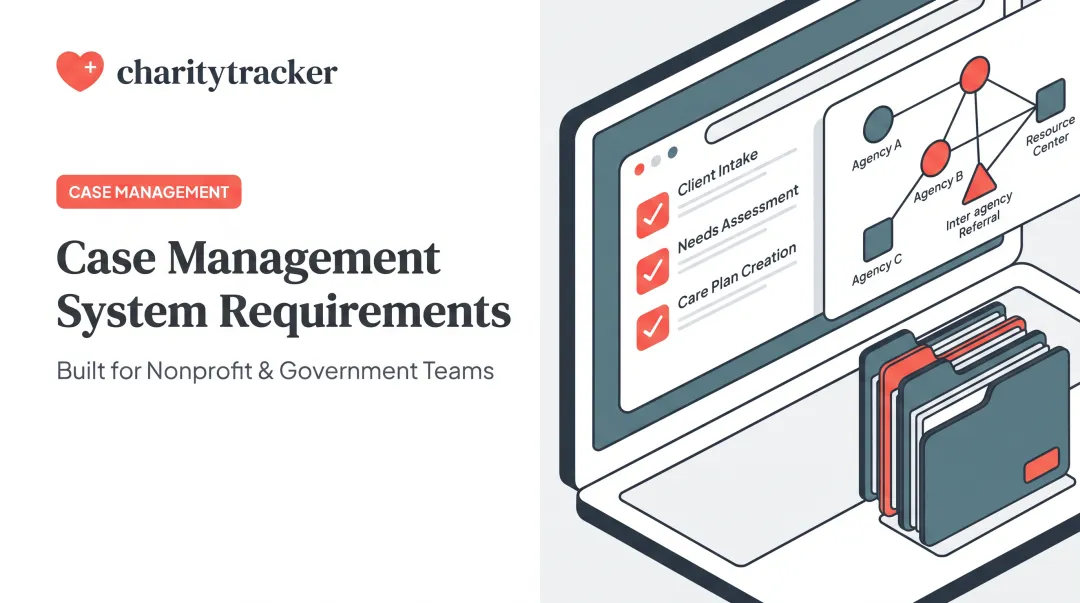
Its built-in inter-agency referral network lets partner organizations coordinate care without duplicating services. Remote and kiosk intake, digital signature capture, and barcode scanning enable fully paperless workflows.
| Best For | Community health and human services organizations needing secure, cross-agency client data coordination |
| Key HIPAA Features | Encrypted client records, role-based access, secure remote intake, audit-ready reporting, 42 CFR Part 2 alignment |
| Pricing & Implementation | Plans starting at $20/month, with the Pro Plan at $60/month; setup and training typically completed within days |
All-in-one human services platforms
All-in-one human services platforms build HIPAA compliance directly into their core architecture and combine case management with donor, grant, and volunteer management under one subscription. They suit organizations that want to consolidate multiple functions without running separate tools.
| Best For | Multi-program nonprofits wanting case management and fundraising tools in one system |
| Key HIPAA Features | Encryption at rest and in transit, role-based access, audit logging, multi-factor authentication support |
| Pricing | Typically flat-rate; commonly ranges from $300-500/month billed annually with unlimited users |
Enterprise impact and outcomes platforms
Enterprise impact and outcomes platforms are designed for larger human services agencies with dedicated IT support, offering deep template libraries for forms and assessments and enterprise-grade compliance infrastructure. Organizations evaluating these tools often need a robust case management application as a foundation. Platforms in this category may carry SOC 2 Type II certification - verify directly with each vendor.
| Best For | Larger organizations with in-house IT resources and complex multi-funder reporting needs |
| Key HIPAA Features | HIPAA-aligned architecture, enterprise access controls, customizable compliance templates |
| Pricing | Per-user pricing on tiered plans; custom quote required based on org size and modules |
Cloud-native configurable case management platforms
Cloud-native configurable case management platforms are purpose-built for social work and human services case documentation, with solid intake and case note functionality at a mid-market price point.
| Best For | Social work and human services teams needing structured, configurable case notes |
| Key HIPAA Features | HIPAA-compliant architecture with BAA available; verify tier requirements with each vendor |
| Pricing | Per-user pricing, commonly starting in the $25-35/user/month range billed annually |
Highly customizable enterprise human services systems
Highly customizable enterprise human services systems handle complex, multi-program workflows for community action agencies and government-funded programs with sophisticated reporting needs.
| Best For | Multi-program health and human services organizations with complex workflows |
| Key HIPAA Features | Enterprise-grade access controls, audit trails, deep compliance reporting |
| Pricing | Custom, quote-based pricing tied to organization size and modules selected |
How to Choose the Right HIPAA Compliant Platform
The most common mistake? Assuming a vendor's "secure" or "compliant" marketing copy equals verified HIPAA compliance. Marketing language carries no legal weight; only a signed Business Associate Agreement (BAA) protects your organization.
Before signing any contract, ask each vendor:
- Is a BAA offered, and how quickly can it be executed? No BAA means no green light to enter ePHI.
- What encryption standard protects data at rest and in transit? Get the specific protocol, not a vague "bank-level security" claim.
- Are audit logs maintained and exportable? You'll need these for compliance reviews and funder audits alike.
- Is multi-factor authentication supported? With the 2026 rule update on the horizon, this is quickly becoming standard practice.

Beyond the checklist, tie the decision to your actual operations. The best-fit platform balances compliance depth with ease of implementation and total cost — particularly for organizations without a dedicated IT compliance staffer. A feature-heavy enterprise platform that takes six months to deploy doesn't help a small clinic or shelter that needs to be operational next week.
Conclusion
Choosing a HIPAA compliant case management partner comes down to operational fit and verified security practices — not brand recognition or the longest feature list. Before finalizing any decision, weigh scalability, implementation speed, and pricing transparency against your organization's actual capacity to manage the platform long-term.
CharityTracker offers HIPAA-aligned security without an enterprise budget or a six-month rollout. Plans start at $60/month with a free trial included, and most teams begin centralizing client data and reporting within minutes. If that fits what your team needs, it's worth a closer look.
Frequently Asked Questions
Are case management systems covered by HIPAA?
Case management systems fall under HIPAA when the organization using them qualifies as a covered entity or business associate handling ePHI. The software itself must also meet HIPAA's technical safeguards, including encryption and access controls.
What is the best HIPAA-compliant case management software?
The "best" platform depends on your organization's size and use case. For healthcare-adjacent human services organizations needing affordability and fast implementation alongside HIPAA-aligned security, CharityTracker is a strong fit.
Do nonprofits and human services organizations need to be HIPAA compliant?
Nonprofits handling health-related client data, mental health records, or substance abuse information, or coordinating directly with healthcare providers, may qualify as covered entities or business associates, even without realizing it.
What is a Business Associate Agreement (BAA) and why does it matter?
A BAA is a required contract between an organization and any vendor handling ePHI on its behalf. It documents safeguards, breach reporting duties, and data handling terms, and it must be signed before any ePHI enters the system.
What features should I look for in HIPAA compliant case management software?
Look for encryption at rest and in transit, role-based access controls, audit trails, and BAA availability. These four elements are non-negotiable regardless of vendor size or price point.
How much does HIPAA compliant case management software typically cost?
Pricing varies by user model and feature depth rather than compliance status. Flat-rate, affordable options like CharityTracker exist alongside enterprise per-user platforms that scale into the thousands monthly.