Case managers juggle intake forms, referral paperwork, and disconnected databases across agencies. The result: duplicated services, missed appointments, and clients who fall through the cracks between systems that were never designed to talk to each other.
This article breaks down what homeless case management actually involves, the models agencies use (including intensive case management), the practices that produce real housing outcomes, and how the right software closes the gaps between programs.
Key Takeaways
- Effective case management blends person-centered, trauma-informed, and Housing First principles for lasting stability.
- Four recognized types (standard, intensive, clinical, and strengths-based) determine service intensity for each client.
- Intensive Case Management (ICM) fits high-acuity clients needing frequent, high-touch support.
- Centralized data and cross-agency coordination prevent duplicated services and track long-term outcomes.
What Is Case Management for the Homeless?
Homeless case management is the coordinated process of assessing a person's needs and building a service plan around those needs. It also means connecting them to housing and support services, then tracking progress until they achieve stability. SAMHSA defines it broadly as linking individuals to services that match their identified goals. That definition applies directly to homeless services work.
Who provides it? A wide mix of organizations:
- Nonprofits and social service agencies running shelters, outreach teams, or supportive housing programs
- Continuums of Care (CoCs) : the HUD-designated regional bodies coordinating homeless assistance
- Government agencies administering HUD, VA, and state-funded programs
- Faith-based organizations operating shelters and transitional housing
Clients range from single adults and families to veterans and unaccompanied youth, each with distinct needs and eligibility pathways.
The Core Stages of the Process
Most case management follows a similar arc, regardless of population:
- Intake and assessment: gathering background, documenting immediate needs, and screening for vulnerability
- Case plan development: setting goals collaboratively with the client
- Service coordination and referral: connecting clients to housing, healthcare, benefits, and employment resources
- Ongoing monitoring: tracking progress and adjusting the plan as circumstances change
- Case closure: formally ending services once goals are met or the client transitions out

HUD requires most CoCs to run this process through a Coordinated Entry system, which standardizes how people access, get assessed for, and get prioritized for housing and services across a community. Rather than each agency running its own intake queue, Coordinated Entry ensures people with the greatest needs get appropriate priority. It also connects directly to HMIS data systems that track outcomes across the whole system.
Coordinated, transition-focused case management has measurable impact. A New York randomized trial testing nine months of Critical Time Intervention against standard services found it reduced the odds of returning to homelessness during the final follow-up period. This evidence shows that structured, time-limited case management works when matched to the right transition point.
Types and Models of Case Management for Homelessness
Not every client needs the same level of support. Agencies typically draw from four core types and layer in homelessness-specific frameworks depending on acuity.
The Four Core Types of Case Management
| Type | Best fit | Key distinction |
|---|---|---|
| Standard/generalist | Clients with moderate, straightforward needs | Broker model: assesses needs and links to outside services |
| Intensive (ICM) | High-acuity, complex clients | Small caseloads, frequent contact, direct coordination |
| Clinical/therapeutic | Clients needing behavioral health support | Combines assessment with therapeutic services delivered by the case manager or team |
| Strengths-based | Clients who benefit from a goals-first approach | Emphasizes abilities, informal supports, and self-direction over deficits |
A first-time job-loss client might only need standard case management and a referral to rapid re-housing. Someone experiencing chronic street homelessness with co-occurring mental illness likely needs ICM or a clinical model layered on top. Agencies routinely blend these types as a client's situation changes.
What Is Intensive Case Management (ICM)?
ICM is a high-touch model built around smaller caseloads and more frequent client contact than standard case management. Research comparing case management approaches has used a benchmark of 15 or fewer clients per worker for ICM caseloads, far below what generalist case managers typically carry.
ICM works best for clients facing:
- Complex trauma histories
- Serious mental illness or substance use disorders
- Repeated cycles of housing instability requiring persistent, coordinated follow-up
ICM vs. Assertive Community Treatment (ACT): These models get confused often, but they're structured differently.
| Dimension | ICM | ACT |
|---|---|---|
| Structure | Individual case manager coordinates services | Multidisciplinary team shares the caseload |
| Availability | Frequent contact, no universal 24/7 requirement | Team-based crisis availability around the clock |
| Caseload | 15 or fewer per worker (common research benchmark) | Roughly 10 or fewer per clinical staff member |
| Best fit | Clients needing coordination across systems | Clients with serious mental illness and major functional impairment |
Homelessness-Specific Frameworks
Housing First prioritizes moving someone into stable housing before requiring sobriety, treatment compliance, or other preconditions. The landmark Pathways study tested this approach on 225 chronically homeless adults with serious mental illness and substance use disorders.
Housing First participants remained stably housed about 80% of the time over 24 months, compared to roughly 30% for a traditional treatment-first group. The intervention combined housing with ACT-level support, so case management worked alongside stable housing rather than replacing it.
Critical Time Intervention (CTI) is a nine-month, three-phase model (transition, try-out, transfer of care) designed specifically for moments of change, such as a shelter-to-housing move. It's built to strengthen a client's ties to community supports before formal case management ends, rather than providing indefinite ongoing service.

Best Practices for Effective Homeless Case Management
The models above only work if they're applied well. A few practices separate agencies that produce lasting housing outcomes from those that just process paperwork.
- Lead with trust. A trauma-informed, person-centered approach acknowledges a client's past experiences before setting expectations or timelines.
- Assess before assigning services. A thorough intake, backed by centralized client data, prevents duplicated referrals and missed needs.
- Co-create the plan. Clients who help set their own goals follow through more consistently than those handed a prescribed plan.
- Build a real referral network. Fast connections to shelter, healthcare, employment, and legal aid matter more than any single service in isolation.
- Stay engaged after housing placement. Employment help, budgeting support, and check-ins reduce the odds of returning to homelessness. HUD's FY2024 data shows a 17.4% return rate within 24 months, underscoring why post-placement support matters.
- Apply cultural competence. Chapin Hall research shows LGBTQ+ youth face a 120% higher risk of homelessness than their peers. Services should reflect that disparity, not identical treatment for every client.
Common Challenges Case Managers Face
Even strong practices run into structural limits.
Workforce strain is real. A 2026 National Alliance to End Homelessness survey of over 5,000 homeless-services workers found 74% reported their organization was understaffed and 71% reported high turnover — with 90% saying turnover increased stress on remaining staff.
Beyond staffing, three structural problems keep showing up:
- Fragmented data. When agencies can't see each other's records, clients get assessed multiple times and services get duplicated instead of coordinated.
- Incomplete client histories. Paper files or siloed databases mean new case managers start from scratch instead of building on prior work.
- Limited housing stock. NLIHC's 2026 Gap report cites a shortage of 7.2 million rental homes affordable to extremely low-income renters, a gap no case manager can close alone.
How Technology Strengthens Homeless Case Management
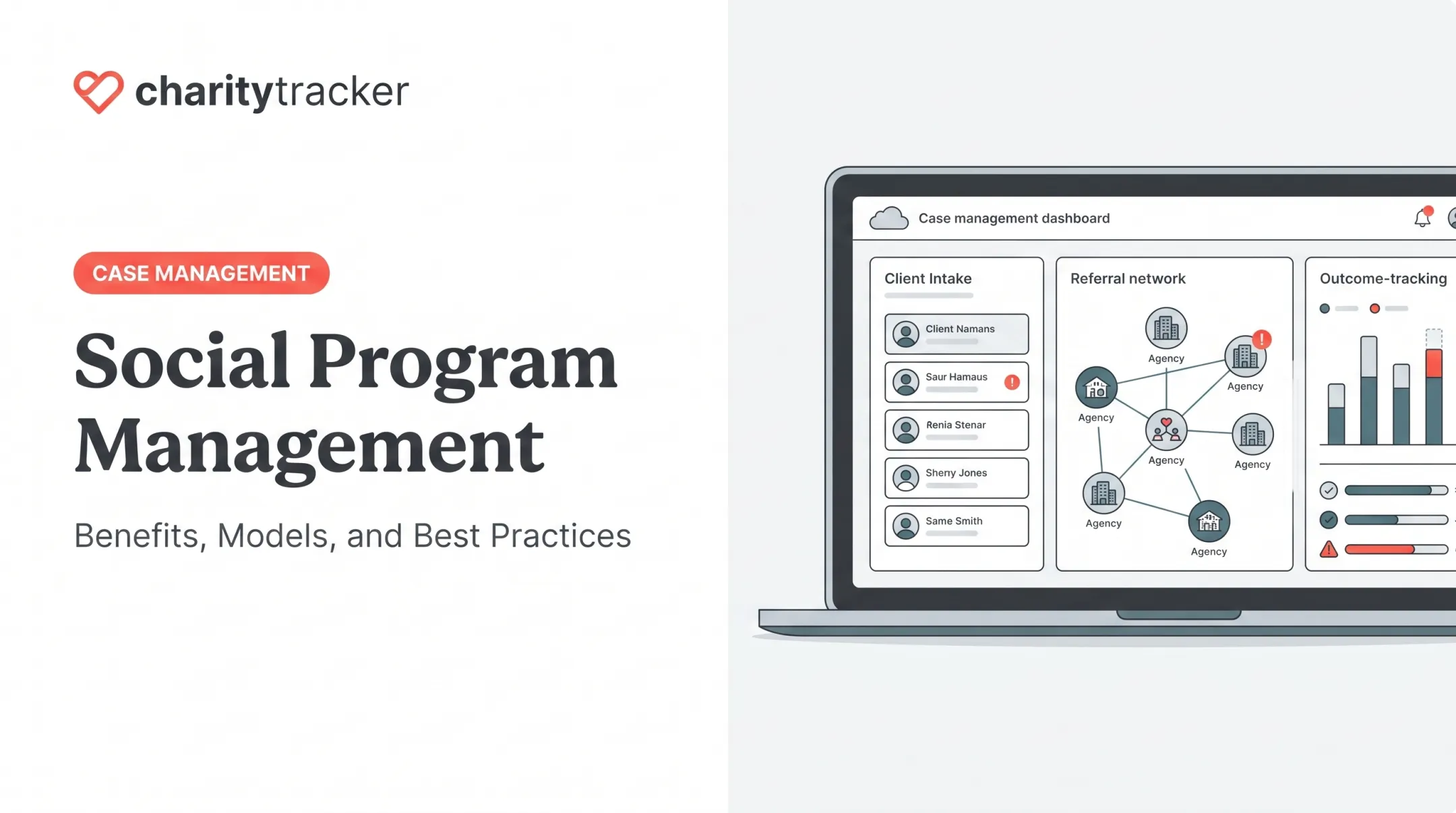
Most of the challenges above trace back to one root issue: information trapped in silos. Case management software addresses this by centralizing client records into a single digital record that follows the person, not the paperwork.
For homeless-serving organizations specifically, a few features matter most:
- Digital intake that captures client information without a stack of paper forms
- Barcode scanning for faster client check-in during high-volume shelter or meal-service hours
- Secure inter-agency referral networks, so a shelter, food bank, and clinic can see the same client history instead of asking a person to retell their story at every stop
- Customizable outcome reports built for funder and compliance requirements
CharityTracker was built with exactly this kind of coordination in mind. One information-and-referral representative said the platform helped cut their paperwork time in half.
"The inter-agency networking function helped us ensure we do not duplicate services and increase capacity."
Organizations like The Salvation Army and Boys & Girls Clubs of America run their case management on the platform today. CharityTracker's Pro plan starts at $60/month, with API access included.

For crisis-driven work, 24/7/365 platform access matters too. Emergency shelter intake and disaster response don't happen on a nine-to-five schedule, so case managers need a system that's available whenever a client shows up.
Frequently Asked Questions
What is intensive case management?
Intensive Case Management (ICM) is a high-touch model with small caseloads and frequent client contact, built for people with complex needs who require rapid, structured support to reach stability goals.
What are the four types of case management?
The four widely recognized types are standard/generalist, intensive, clinical/therapeutic, and strengths-based. They differ mainly in caseload size, contact frequency, and how much clinical support is built into the model.
What is the Housing First model?
Housing First places people in stable housing without preconditions like sobriety or treatment, then addresses other needs afterward. It significantly outperforms treatment-first models in housing retention rates.
How does case management help reduce homelessness recidivism?
Ongoing support after housing placement, including employment help, budgeting assistance, and regular check-ins, addresses the issues that cause people to lose housing again. Coordinated services also catch warning signs earlier.
What software features matter most for homeless service case management?
Centralized client data, digital intake, and secure inter-agency referral capabilities top the list — features built into platforms like CharityTracker. These prevent duplicated services and give case managers a full picture of each client's history.
Who typically provides case management for people experiencing homelessness?
Nonprofits, Continuums of Care, government agencies, and faith-based organizations most commonly staff these roles, often coordinating through a community's Coordinated Entry system.