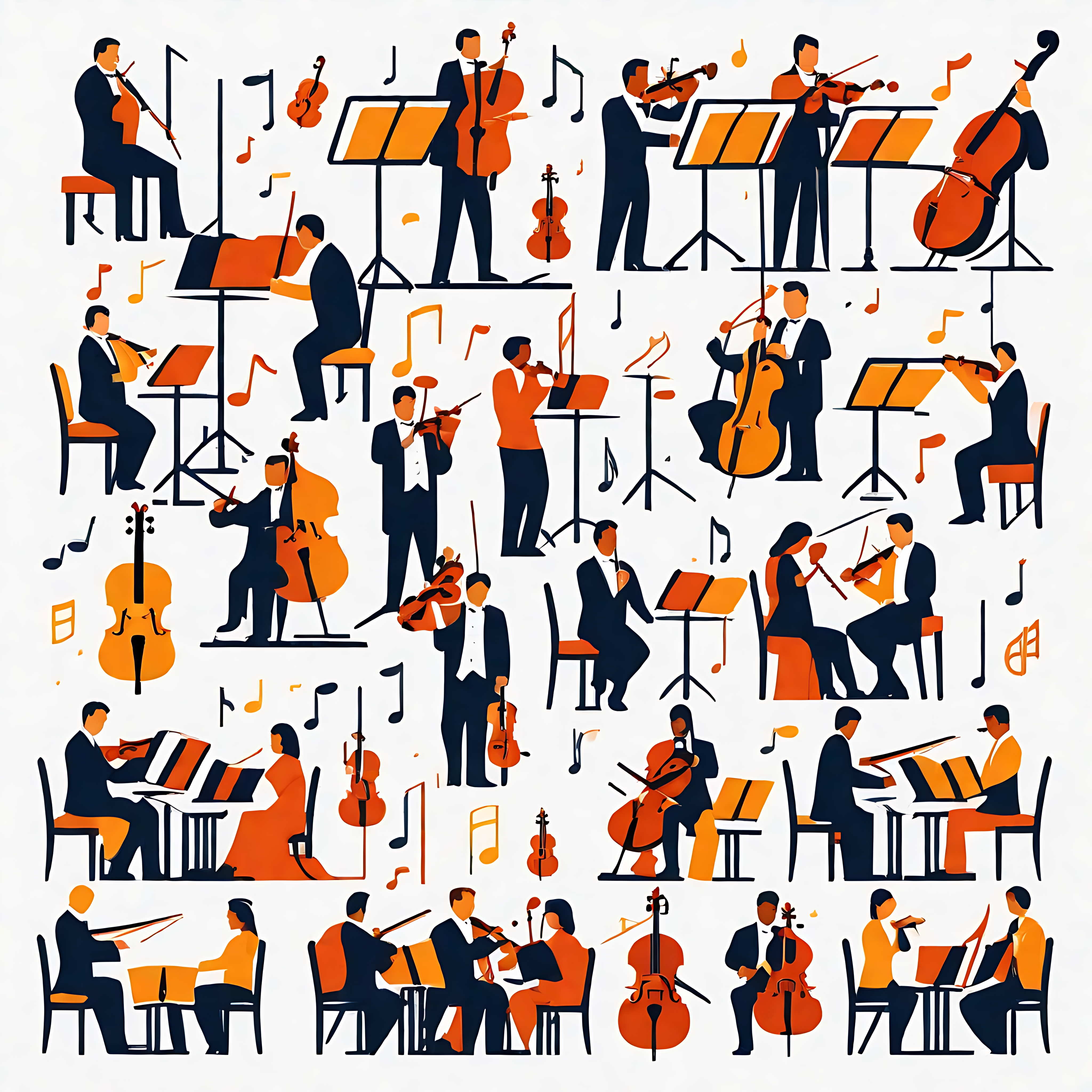
One of my bucket list items is to conduct a symphony orchestra. I’m only asking for one piece, so it’s not too big of an ask, right? The orchestra would probably be so well rehearsed that even if I were a miserable conductor, they would do just fine. Of course, the orchestra’s need for conducting could depend on the piece's complexity.
Choir and orchestra conducting have taken various forms over thousands of years. Much of it has been determined by the size of the choir or orchestra. A small choir or chamber orchestra can be led by one of the musicians as a choirmaster or a lead instrumentalist. As choirs and orchestras grew in size, diversity, and complexity, the need for a front-and-center conductor emerged.
Conducting can be dangerous work. One of the earliest conductors, Jean-Baptiste Lully, died from his conducting. Known for his use of a six-foot staff with which he pounded the floor to keep time, he hit his foot in a rehearsal. His foot never healed, and he eventually died from gangrene.
Some would say there is no difference between a conductor and a maestro, other than the language the words represent. But even different languages bring nuance to the image and feel of the idea. For instance, the French word for conductor is chef d’orchestre. A cook and a chef are not the same, nor are a conductor and a maestro.
The distinction of a maestro includes experience, but it’s way more than that. Evidence over time goes beyond proven technical accuracy and acceptability, and moves into style and artistry. A maestro begins to have distinguishing characteristics.
Artistry isn’t only left to the composer, vocalists, or instrumentalists. A maestro knows how to draw special capacities out of an orchestra and create special ebbs and flows that are interpretations of what is on the score. It’s as if they see beyond the music on the page and with a multi-dimensional vision and understanding into which they lead the orchestra and, thus, the listener.
All of these elements are the maestro leading and preparing the orchestra. They don’t just show up and perform the playing of notes. The cultivation done in rehearsals creates what will emerge for public experience. Maestros nurture an atmosphere and activity that transcends and transforms.
And so leads the community maestro.
Conducting meetings, presentations, and conversations yields a plethora of information, opinions, definitions, and models. The community maestro displays an uncanny ability to draw on the strengths of all, coalescing them into cooperative actions that bring about the desired change.
The Community Maestro’s Intention
Intention – a mental determination, purpose, or aim to achieve a specific result
“Who are you and why are you here?” Have you ever had that thought about someone who is in or leading, or newly joining, a meeting you are part of? Questioning intentions is not an abnormal response to a voice in your space, especially if they are new. This question can take longer to answer for some than for others, both because of the person wondering and the person still to be known.
You have questions about these details because you don’t know them, and knowing them matters. Some of us lean toward assuming the best or assuming the worst about someone until it’s proven otherwise. Others begin in neutral space. What is most interesting here is how often we actually attribute our own intentions to others.
I start with intentions, because everything really comes from here. Known or not, the intention is there. This is the reason why a person is present and involved. Why you do what you do impacts how you do it, and with whom. What is the ultimate driving force in that person? What is the ultimate idea (purpose) that a person hopes to have happen or plans to carry out?
The community maestro has a gift for making it clear they are for the good of the community. They're not in it for self-aggrandizement, and the people believe that. Although they may find it difficult to simply be a follower, it’s not because they need the credit. They just see too much to only be a follower; what they see, they speak, and what they speak stirs people. More on that below.
Attitude tends to be a felt reality, making it atmosphere-creating. Intentions are shown through attitude. The community maestro knows the influence of attitude on the atmosphere and controls that flow. (To explore this “attitude” idea more, invest some time with my article Attitudinal Current.
Clarity of intention is found over time, sitting with the abundance of information a leader absorbs. Let’s learn more about the power of reflection and how it shines light on the future.
The Community Maestro’s Contemplation
Contemplation – deep, focused, quiet reflection
The power of time alone to think, see, listen, reflect, and even feel moves a leader from being a conductor to a cultivator. Some of it is about being inspired so that they can inspire, which we will look at more.
Contemplation moves to deeper levels of exploration and observation. Observing from the surface will produce surface responses. Looking deeper tells you more. This thoughtful slowdown is the pathway of shifting outputs and outcomes. Contemplation cultivates the capacity to look for the why of community problems, not just see that they are there.
For instance, why does hunger persist in your community? People don’t have enough food. Why don’t they have enough food? Because they lack income. Why do they lack income? And you keep asking why, contemplating every bit of evidence.
The contemplative can keep exploring for bottom-line answers because they have cultivated the ability to sit quietly, purposefully, and more completely with the problem’s layers and myriad of factors.
The non-contemplative leader can miss evidence, resources, connections, strategies, and insights. Busy blows past important information, relationships, and resources. Stopping is a choice.
What I have found is that scheduling contemplative practice as a rhythm makes me more contemplative along the way and with the crowd. It helps me pay more and better attention. The regular practice of extended silence and stillness cultivates the ability to edit out the noise to find what really matters.
Instrumental music or being in the sounds of nature can help. Avoid music with words in your contemplation; they will hijack your brain…and the rest of you. Learn to sit quietly with what you know and allow what you don’t know to emerge as connections are made.
The community maestro doesn’t operate at a surface level personally or in the community because of this contemplative nature. Their observation skills are expansive, their interpretation skills are deeply insightful, and their facilitation skills are engaging, patiently drawing out of the deep wells in the room.
The contemplative community maestro will see critical information, pathways, and possibilities that others don’t see without being shown. It’s to this visioning capacity that we now turn.
The Community Maestro’s Vision
Vision – vivid mental image, foresight, or strategic goal for the future
Vivid image. Those are powerful words. I wear glasses. Without them, there is nothing vivid about what I see. Everything is blurry, which is disorienting and discouraging. But if I go without them long enough, I adjust to the blurry.
Some communities have gone without glasses so long that they no longer realize they are walking in a blur. Living with blurry vision leads to acting less confidently for fear of what might be there that you're not seeing correctly.
This vision of a community maestro isn’t only sharp but also a full-sensory video, not a series of still shots. It’s like a superpower. I had a friend describe it as seeing in technicolor video what others see in black and white. It’s a capacity, as I mentioned earlier, of being able to see the score of music, but somehow seeing more than what’s on the page.
Infused in visioning capacity is imagination, because it’s seeing what doesn’t yet exist. Like an architect taking in general ideas of what is desired and needed and designing what could be, but is not yet. The vision is a video blueprint that can be edited during the buildout. But the blueprint is needed to start the activity.
The community maestro is a vision enhancer. Who do you know in your community who brings that power every time they enter a conversation or facilitate one? This person is not a sideliner. They have a strength that needs to be very engaged.
It’s one thing for a community maestro to have a vision of where to go, but to give voice to that vision in a way that moves people is another capacity.
The Community Maestro’s Inspiration
Inspiration – stimulated mentally or emotionally, especially toward creativity; drawing in a breath.
As human beings, we tend to look for inspiration. What inspires one person doesn’t necessarily inspire another. One of the interesting capacities of a community maestro is their ability to inspire across many kinds of people groups. Resilience experts call them a translational leader.[i]
We like being inspired because it breathes life into us, when daily life has a way of sucking it from us. It’s those movies and songs that you know will stir your deepest self into believing again. I call them treadmill movies and music. They help keep you from giving up.
In community work, inspiration has a voice. A voice can impact you significantly, and not always for the better. You can probably think of a voice that you can only take so much of hearing. Whether the timbre or the topic it tends to vocalize, you know there is a limit.
But there’s another kind of voice that draws you in. You can’t even define why, only that it inspires, it breathes life into you. It’s a voice that helps you believe something can be done; we just need to find the way.
The community maestro has that inspiring voice. What they say, how they say it, and the literal sound waves from their voice somehow create a resonance deep in the soul. The stirrings of inspiration dissipate the stagnancy that comes from being tired, confused, hopeless, and discouraged.
Inspiration breathes life, hope, and vision into us, helping us get moving again.
The Community Maestro’s Connection
Connection – the relationship or link between people, things, or ideas.
Work in communities can be like a myriad of disconnected dots, where everyone serves in their space, doing their best with what they have to help as much as they can. Disconnected, those dots are an incomplete picture of a community’s capacity to help turn lives around from their worst to their best, from their weakest to their strongest, from abused and in bondage to healed and set free.
Connecting the dots, like notes on a score, the community maestro recognizes shared hearts, hopes, and visions that move from the practice of scales and arpeggios into the symphony everyone is waiting for. Then, from what the community maestro sees behind the score, through clarity of vision and vibrancy of inspiration, they move the people into coordinated community-restoring action.
We are better together.
But together doesn’t just happen. Someone must see the need to foster connections and then send emails and texts, make calls, set up appointments, and sometimes just show up to get the conversation started. And they do it over and over and over again, because of the connections they see and the results that will come from clarity, persistence, and the right atmospheric conditions.
Clifton Strengths, by Gallup, notes that someone with this capacity not only sees connections but also believes deeply that they matter to a larger purpose.[ii] This is based on the intent and vision described above. To the community maestro, it’s all connected; they never operate in isolation or isolated thoughts.
Relational connection goes beyond connecting over the “things” we want to accomplish. Merely conducting business doesn’t connect us deeply enough on a personal level to cultivate sustainable relationships of trust that remain connected.
One more thing about this characteristic of connection. There has been a loss of statesmanship. A statesman or stateswoman exists where respect is high, and trust runs deep. The growing challenge of polarization is a washout of the bridge that once made way for standing in between disparate ideas to discuss, to learn, and to try to find more shared ground.
The community maestro actually becomes the bridge where there is no bridge until one is constructed again. The room feels, sounds, looks, and acts differently when a community maestro is there, making the connections that were they not there, might never happen.
This is the end of Part 1. Who has come to mind so far, as these characteristics have been unpacked? Could it be you?
PART 2 OF “10 Characteristics of the Community Maestro” is COMING SOON! Want to know when Part 2 posts? Subscribe at charitytracker.com/blog.
[i] Zolli, Andrew and Ann Marie Healy. Resilience: Why Things Bounce Back. New York, NY: Free Press, 2012.
[ii] https://www.gallup.com/cliftonstrengths/en/252197/connectedness-theme.aspx
Do you desire to strengthen your CharityTracker or OasisInsight network and achieve new levels of collaboration and impact? Reach out to Chuck today to schedule your conversation: chuck@simonsolutions.com.
 Dr. Chuck Coward serves as Community Impact Specialist for Simon Solutions, Inc. Chuck has invested nearly forty years in fostering human and community development from a variety of places and roles, including as a pastor, non-profit Executive Director, Director of Development, businessman, consultant, university professor, The Struggle Coach, and the founder of Entrusted Foundation. His great passion is to help people and communities grow stronger. Chuck is the proud husband of Anita, dad to four, and granddaddy to nine.