That shift is putting pressure on case managers who've spent years tracking activity with spreadsheets, paper intake forms, and sticky notes. You can count sessions delivered. You can't easily show whether those sessions actually moved someone toward stable housing or a steady paycheck.
Federal award rules already require recipients to relate their reporting to the actual objectives of the funding, not just log activity 2 CFR 200.329. Without a structured way to capture outcomes, case managers struggle to prove what's working, renew grants, or figure out which interventions deserve more resources.
This guide breaks down the frameworks, metrics, and technology that make outcomes measurement realistic for case management teams — not just an annual scramble before a grant report is due.
Key Takeaways
- Outcomes track client change; outputs only count services delivered
- A solid framework starts with a theory of change and consistent intake-to-closure data
- Case management software centralizes outcome data and kills duplicate entry
- Every core function from intake through evaluation generates outcome data when you capture it correctly
- Tracking every closure type (not just successes) prevents skewed reporting
Outputs vs. Outcomes: Understanding the Difference
Outputs measure volume: classes taught, sessions delivered, referrals made. Outcomes measure benefit: whether a client's knowledge, behavior, or circumstances actually changed, per United Way's outcomes framework.
Example: "We provided 200 housing counseling sessions" is an output. "62% of clients achieved stable housing within 90 days of case opening" is an outcome.
Funders increasingly care about the second number. Federal reporting rules require grantees to compare accomplishments against stated objectives—not just tally activity—and those requirements tighten further when budgets, staffing, or program scope change (2 CFR 200.329).
Quick reference:
| Output | Outcome |
|---|---|
| Number of clients served | % who achieved stable housing |
| Referrals made | % who followed through and secured services |
| Sessions delivered | % who reported improved well-being at closure |

Neither number alone tells the full story. Funders want both, and outcomes are what prove impact.
Building an Outcomes Measurement Framework for Case Management
Before picking a tool, define what you're actually trying to measure.
Start With a Theory of Change
A theory of change states who you serve, what change you intend, and over what timeframe. Work backward from the outcome you want, then map the outputs and activities that should lead there.
Pick 3-4 focused outcome domains instead of trying to measure everything:
- Housing stability
- Employment
- Mental health or wellbeing
- Family stability
Trying to track ten domains with a small staff usually means tracking none of them well.
Standardize Your Data Collection Points
Consistency matters more than sophistication. Lock in three checkpoints:
- Baseline at intake — document the client's starting condition
- Progress checks during service — periodic reassessment
- Outcome recording at closure — final status, including incomplete cases
Connect the 5 Core Functions to Outcome Data
Every core case management function already generates outcome data if you're capturing it:
- Assessment — establishes the baseline
- Planning — sets the target outcome and timeline
- Implementation/coordination — logs the interventions delivered
- Monitoring — tracks progress against the plan
- Evaluation — records the final outcome at closure

Avoid Survivor Bias
Here's a mistake that wrecks outcome data: only recording the successful closures. In Hill and Rosenman's selection effects study of a parenting program, only 52.3% of attendees completed both pretest and posttest, and completion itself correlated with better outcomes. If you only report on completers, your numbers look better than reality.
Fix: Track every closure type — successful, incomplete, and dropped — and report all of them.
Essential Tools and Metrics for Measuring Case Management Outcomes
You don't need dozens of tools. You need a few that talk to each other.
Common tools used in case management include:
- Intake and assessment forms that capture baseline needs
- Standardized scales (like self-sufficiency matrices) for scored progress
- Goal-tracking modules tied to client action plans
- Case notes that document services and milestones
- Reporting dashboards that surface trends for funders
Pre/Post Comparison Reporting
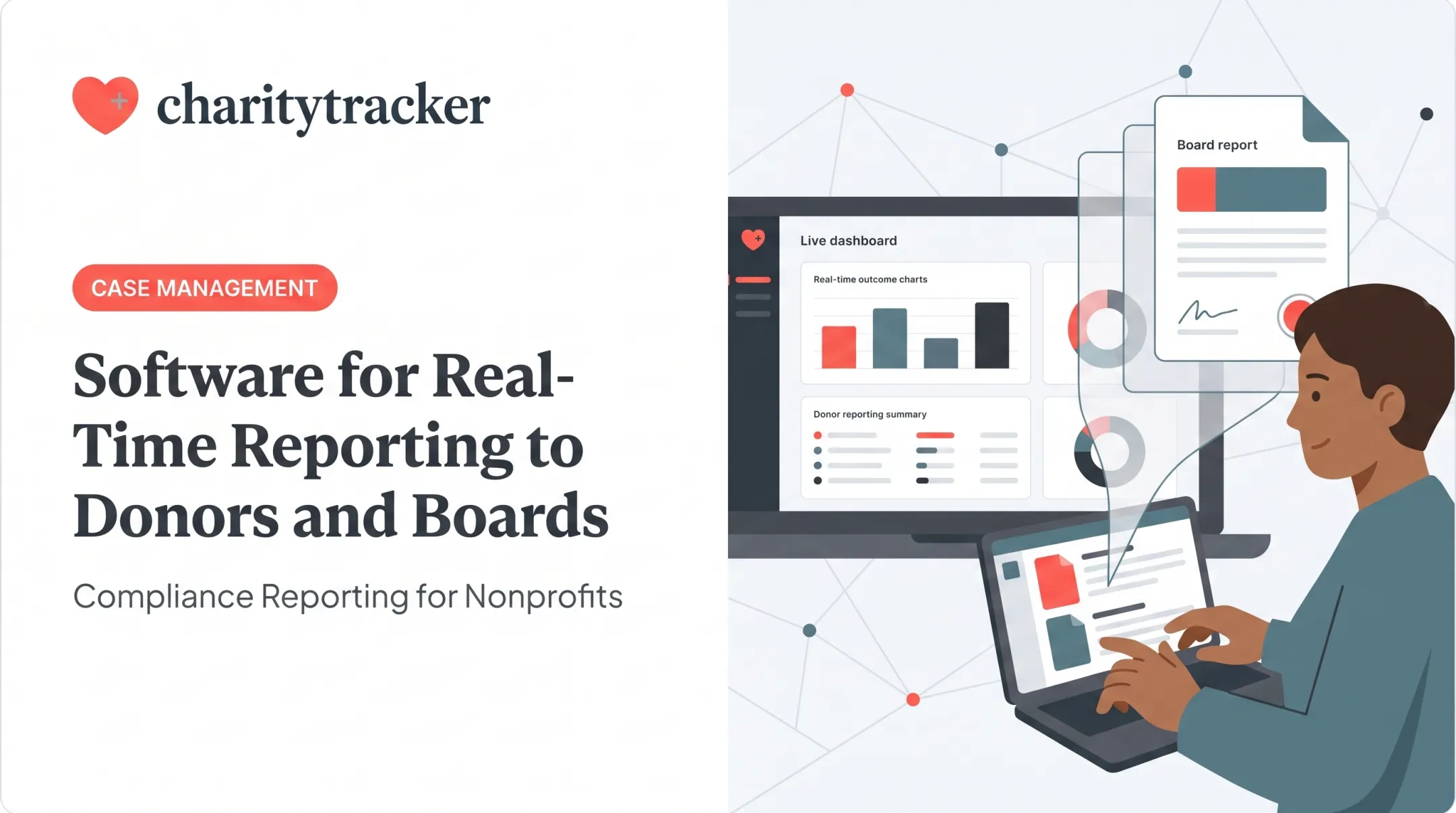
A "changes over time" report — comparing baseline scores to progress and closure scores — is one of the clearest ways to show measurable client progress to a board or funder. It turns scattered case notes into a visual trend line for metrics like housing stability, income change, and goal completion rates.
Reduce Errors at the Source
Clean data starts at intake. When forms are incomplete or re-keyed by hand, outcome numbers lose credibility with boards and funders.
- Digital signature capture eliminates the need to re-key information from paper forms
- Remote and kiosk intake let clients enter their own information, cutting transcription errors and freeing up staff time
- Standardized assessment fields keep scores comparable across clients and time periods

Don't Skip Inter-Agency Data Sharing
If three agencies are helping the same family without knowing it, you're duplicating effort and muddying your outcome data. Inter-agency data sharing tools show what services a client has already received, which:
- Prevents duplicate assistance
- Gives a fuller picture of collective community outcomes
- Helps agencies coordinate rather than compete for the same clients
How CharityTracker Simplifies Outcomes Measurement for Nonprofits
CharityTracker centralizes a client's entire history into one digital record, from intake through closure. Instead of separate files for each program touchpoint, one profile holds:
- Demographic data
- Needs assessments
- Service interactions
- Case notes
- Outcome checkpoints
That structure removes the duplicate-entry problem most case managers know well. Built-in search helps staff find an existing record before creating a new one, so baseline and follow-up data stay attached to the same client.
The Changes Over Time Report
This built-in report compares baseline assessments to later checkpoints, showing how a client's circumstances and goals shift across their case history. It's available in the Pro Plan at $60 per user per month, along with customizable assessments and API access.

Inter-Agency Referral Network
CharityTracker's referral network gives authorized staff at participating agencies visibility into a client's existing assistance history before delivering more support. Organizations using this network report roughly a 20% reduction in duplicated efforts, based on CharityTracker's internal data. Cleaner handoffs mean outcome data reflects real progress, not repeated services counted twice.
Fast Implementation
New accounts typically receive confirmation within 5-10 minutes, and teams can start capturing outcome checkpoints shortly after. There's a 14-day free trial and no onboarding fees.
That speed matches how the product was built. CharityTracker's roots trace back to 2026, when it was created during Hurricane Katrina relief efforts to coordinate emergency assistance. It now serves 2,500+ communities across the U.S., including organizations such as The Salvation Army and Boys & Girls Clubs of America.
Common Pitfalls in Outcomes Measurement
Even with the right tools, a few habits will undermine your data.
- Inconsistent recording across staff. If one caseworker scores "housing stability" differently than another, your outcome data isn't comparable. Lock definitions in a shared data dictionary and calibrate periodically.
- Skipping closure documentation. This is the single most common gap. A case that just goes quiet, without a recorded outcome, leaves a hole in your evidence.
- Overclaiming attribution. Your program probably contributed to a client's gains—not caused them—unless you ran a controlled comparison. Funders respect honest framing more than inflated claims.
Frequently Asked Questions
What are some common tools used in case management?
Common tools include intake and assessment forms, standardized scales, case management software dashboards, and reporting tools. Together, they capture data from intake through closure without relying on paper files.
Can you give me an example of an outcome measure?
A common example is the percentage of clients who achieve stable housing within 90 days of case opening, measured from intake baseline through case closure. Employment placement rates work the same way.
What are the 5 core functions of case management?
The five core functions are assessment, planning, implementation/coordination, monitoring, and evaluation. Each one generates a piece of outcome data if it's tracked consistently.
How often should outcomes data be reviewed?
Most organizations should review aggregate outcomes quarterly, with case-level reviews at intake and closure. This catches problems before annual reporting deadlines.
What's the difference between outputs and outcomes in nonprofit reporting?
Outputs count activity, like number of clients served or sessions delivered. Outcomes measure actual client change, like improved housing stability or employment status.
How can small nonprofits start measuring outcomes without a large budget?
Start with affordable case management software and 2-3 focused outcome domains instead of trying to measure everything at once. CharityTracker's Pro Plan, for example, starts at $60 per user per month with a free trial to test the approach first.