Human services case management is the coordinated process of connecting individuals and families to housing, health, financial, and social support across multiple agencies and programs. It's the glue holding together an otherwise disconnected safety net.
The problem? Many caseworkers spend far more time on documentation than on the families they serve. North Carolina's 2026 Child Welfare Workload Study found caseworkers spent just 11.4% of their time in direct contact with families, while 14.8% went to documenting case activity — climbing to 17.1% in small counties. (NC DHHS, 2026)
This guide breaks down the roles, principles, models, and process steps behind human services case management, plus how the right software cuts the paperwork burden.
Key Takeaways
- Case managers coordinate housing, health, financial, and social services rather than acting as sole service providers
- Case management follows five core steps: intake, planning, implementation, monitoring, and evaluation/closure
- Models range from brief brokerage referrals to intensive, hands-on support for complex cases
- Confidentiality and inter-agency coordination sit at the core of ethical case management practice
- Centralized platforms like CharityTracker help agencies cut documentation time and avoid duplicate service delivery
What Is Human Services Case Management?
Human services case management is a collaborative, client-centered process that connects people to social, medical, and community resources. NASW defines it as a process to "plan, seek, advocate for, and monitor services from different social services or health care organizations and staff on behalf of a client."
Case management is not the same as clinical social work. Case managers assess needs, coordinate referrals, and advocate for services. Clinical social workers, by contrast, hold a master's degree, supervised clinical training, and state licensure to provide direct psychotherapy. A case manager might refer a client to a clinical social worker — but they aren't necessarily one themselves.
Where This Work Happens
This coordination role shows up across a wide range of settings:
- Nonprofits, food banks, and pantries
- Government social service agencies
- Hospitals and healthcare organizations
- Faith-based ministries and churches
- Veteran and military family services
- Domestic violence shelters and disaster relief networks
That coordination gap is what led to CharityTracker. The platform launched in 2026 when community leaders in Florence, Alabama, coordinated Hurricane Katrina relief and saw how paper trails and disconnected systems slowed help to families in crisis. That experience shaped a tool now used across more than 2,500 U.S. communities.
The Role of a Human Services Case Manager
Core Responsibilities
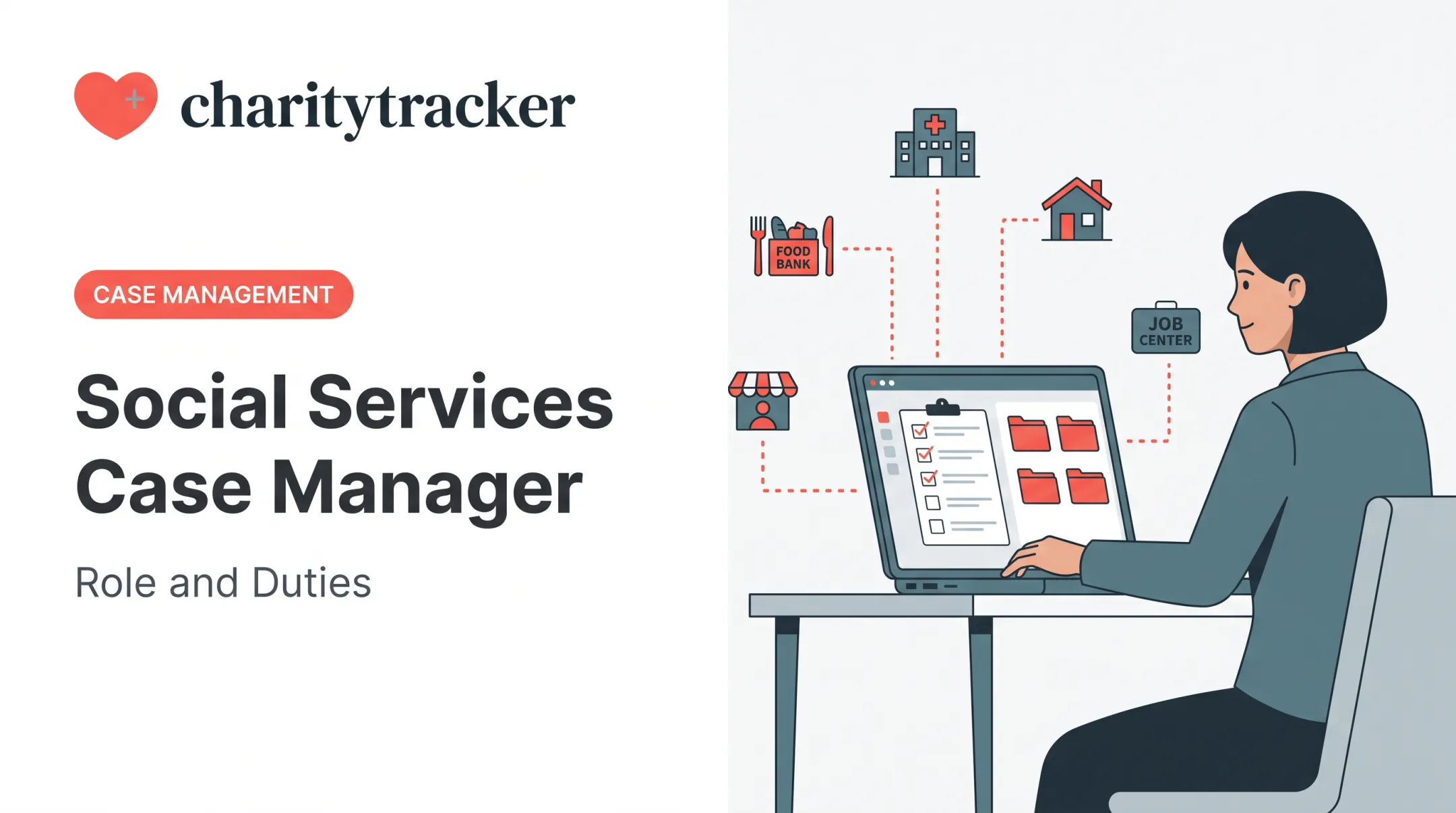
A case manager's day-to-day work centers on five recurring tasks:
- Conduct intake assessments — identify needs spanning housing, food, employment, health, and legal issues
- Develop individualized service plans — build goals around each client's specific circumstances and strengths
- Coordinate referrals — connect clients with partner agencies while avoiding services they've already received
- Monitor progress — document outcomes and adjust plans as circumstances change
- Advocate for clients — help them navigate Medicaid, housing authorities, and other complex benefit systems

Each of these steps depends on accurate, shared information. When a caseworker doesn't know what another agency already provided, the risk of duplicate effort and wasted resources rises quickly.
Skills and Qualifications Needed
Most case manager roles require a bachelor's degree in social work, psychology, or a related field, though requirements vary by employer and program. The Bureau of Labor Statistics notes that the broader "social and human service assistant" category often accepts a high school diploma as the entry point.
Beyond formal education, strong case managers bring:
- Clear, empathetic communication
- Cultural and linguistic competence
- Organizational discipline (caseloads add up fast)
- Analytical problem-solving under pressure
Key Principles of Human Services Case Management
Good case management rests on a handful of non-negotiable principles.
- Client-centered, strengths-based care. Plans build on what a client already has going for them, not just deficits. Dignity and autonomy are foundational.
- Holistic support. Physical, mental, financial, and social needs rarely sit in isolation. A housing crisis often arrives with job loss, health issues, or family strain—treating them separately misses the point.
- Confidentiality and data security. NASW's Code of Ethics requires case managers to protect client privacy and limit disclosures to appropriate purposes. In practice, that means secure records, informed consent, and careful documentation. CharityTracker supports these standards with 256-bit SSL encryption, ISO 27001 and FISMA-compliant hosting, and daily backups across multiple U.S. server locations.
- Inter-agency collaboration. No single agency can meet every need. Coordination prevents gaps and duplication. CharityTracker's inter-agency referral network lets partner agencies see what assistance a client already received before offering more, contributing to a reported average duplication reduction of 20% across collaborating agencies.
- Regulatory adherence. Bodies such as NASW and CSWE set the ethical guardrails that keep practice consistent and accountable.

Common Steps in the Case Management Process
The Case Management Society of America frames this work as a cycle of assessment, planning, coordination, and evaluation. In practice, it breaks into five steps:
- Intake and assessment — gather information on circumstances, needs, and immediate risks
- Planning — build a tailored service plan with measurable, client-specific goals
- Implementation — connect clients to referrals, resources, and providers
- Monitoring and follow-up — track progress and adjust the plan as things change
- Evaluation and closure — document outcomes for funders and compliance reporting

That last step matters more than it might seem. Funders want proof of impact, and regulators want proof of compliance. Skipping documentation here risks audit findings, delayed reimbursements, and weaker grant renewals. Keeping intake-through-closure records in one system makes that proof far easier to produce.
Types of Human Services Case Management Models
Not every client needs the same level of involvement. A 2026 peer-reviewed review found that models differ mainly in service intensity and ongoing case manager involvement.
| Model | Approach | Best Fit |
|---|---|---|
| Brokerage | Brief assessment, quick referral, minimal follow-up | Clients who mainly need navigation help |
| Strengths-based | Builds on client abilities and existing networks | Clients working toward independence |
| Clinical | Combines resource coordination with medical/behavioral health services | Clients needing integrated clinical support |
| Intensive | Frequent, hands-on contact with smaller caseloads | Complex, high-need situations |

Matching the model to the client avoids two common failures: under-serving someone with complex needs, or over-investing resources in someone who just needed a referral.
How Technology Streamlines Human Services Case Management
Paperwork is where good intentions go to die. Every intake form filled out twice, every report built by hand for a different funder — it adds up.
CharityTracker was built specifically to reduce that burden. One customer, Nathaniel R., an Office Clerk and First Call for Help Representative, put it simply: "The software is so user-friendly that I have cut my paperwork time in half, at least!"
Features That Cut the Burden
- Remote/kiosk intake — clients complete forms digitally, anytime, cutting staff data entry
- Digital signature capture — agreements and releases stored securely, no filing cabinets required
- Barcode scanning — speeds up check-in and reduces repetitive data entry
- Inter-agency referral network — authorized agencies see prior assistance before adding more, directly addressing duplicate service delivery
Organizations like The Salvation Army and Boys & Girls Clubs of America use CharityTracker to build customizable assessments, track outcomes over time, and generate funder-ready reports without building separate materials from scratch.

Compliance Reporting Made Easier
For agencies serving specific federal programs, CharityTracker provides customizable funder and grant reports that agencies can shape to their own submission requirements. Reports export to CSV or Excel for grant submissions.
Those same tools stay within reach for smaller agencies. The Pro plan starts at $60/month per user and includes assessments, remote intake, and API access. Lower tiers start at $20/month for teams that need fewer features.
Frequently Asked Questions
What are the common steps in human services case management?
The process typically follows five steps: intake and assessment, planning, implementation (connecting clients to services), monitoring progress, and evaluation with case closure.
What are the key principles of human services case management?
Core principles include client-centered, strengths-based care; holistic support across needs; strict confidentiality; and inter-agency collaboration that prevents service gaps or duplication.
What are the different types of human services case management?
The four main models are brokerage (brief referral), strengths-based, clinical (paired with medical/behavioral health), and intensive (high-contact support for complex cases).
How is case management different from social work?
Case managers coordinate and refer clients to services. Clinical social workers, who need a master's degree and state licensure, often provide direct therapeutic care instead.
What qualifications do you need to become a human services case manager?
Most roles prefer a bachelor's degree in social work, psychology, or a related field, though some entry-level positions accept relevant experience in place of a degree.