That's the tension most community nonprofits, government agencies, and human services organizations live with every day.
Impact measurement is the process of tracking real-life outcomes, not just how many people walked through your door. This guide covers the best methods, a step-by-step plan for building your own measurement system, and how software like CharityTracker takes the manual grind out of the process.
Key Takeaways
- Pair quantitative outputs with qualitative outcomes to show what is actually changing for clients
- Let a simple theory of change drive KPI selection—not the reverse
- Centralized case management software cuts paperwork and stops duplicate service delivery
- Measure continuously, not only at year-end, so you can fix problems while programs still run
What Is Impact Measurement and Why It Matters
Impact measurement means collecting and analyzing data to determine the real-life outcomes of a program. It's different from simply counting how many meals you served or how many families you saw.
Outputs are the numbers: 500 food boxes distributed, 120 intake appointments completed. Outcomes are what happened as a result: a family achieved stable housing, a client found employment, a survivor reconnected with support services.
A food pantry that hands out 10,000 pounds of food has a strong output number. But did it reduce food insecurity for those households over the following six months? That's the outcome question, and it's the one funders increasingly want answered.
Benefits of Effective Impact Measurement
Measurement isn't just a reporting exercise. Done well, it:
- Improves program design by revealing which services change client outcomes
- Builds funder confidence through concrete, documented results
- Increases accountability to boards, staff, and the community you serve
Transparency pays off financially, too. Candid's 2026 analysis of nearly 149,000 nonprofits found that organizations with a Candid Seal of Transparency averaged 62% more in donor contributions than those without one. The study notes this is an association, not proof of causation, but the pattern is hard to ignore.
Trust with funders is only half the picture. Engaging clients and community members in measurement surfaces blind spots staff may never see on their own. A program that looks successful on paper might be missing key barriers your own staff never noticed.
Best Methods for Measuring Impact
Most credible measurement plans don't rely on a single method. They blend at least two, because each answers a different question.
Pre/Post Measurement
This compares a baseline assessment at intake to a follow-up assessment at exit. It's straightforward: measure where a client started, measure where they ended up. The National Academies' welfare reform framework notes that while pre/post designs suggest outcomes are related to a program, isolating the program's effect from outside factors remains difficult.
Longitudinal Measurement
Longitudinal, or monitoring, studies follow clients over a longer period, sometimes well past program exit, to see whether change actually holds. Did the housing placement last? Did the employment stick? This method doesn't isolate cause, but it does reveal durability.
Qualitative Methods
Numbers rarely explain "why." That's where interviews, case notes, open-ended surveys, and focus groups come in. The CDC's program evaluation framework recommends these methods specifically to capture context, motivation, and lived experience that numbers alone miss.
Benchmarking
Benchmarking measures your outcomes against similar programs. The Urban Institute's Outcome Indicators Project applies a common framework across 14 program areas, letting organizations compare performance against peers rather than just against their own history.
Side by side, the four methods answer different questions:
| Method | Question It Answers | Example Use Case |
|---|---|---|
| Pre/post | Did change happen? | Intake-to-exit financial stability assessment |
| Longitudinal | Did change last? | Six-month housing stability check-in |
| Qualitative | Why did change happen? | Exit interviews explaining what helped most |
| Benchmarking | How do we compare? | Comparing shelter length-of-stay to peer agencies |

Step-by-Step Best Practices for Building an Impact Measurement Plan
Building a measurement system doesn't require a research department. Follow these five steps:
Revisit your program goals. Build a simple theory of change: what activities lead to what outcomes, and why. The Urban Institute recommends starting with outcomes and working backward to the activities that produce them.
Select a small number of meaningful KPIs. Tie each one directly to your theory of change. Tracking 30 metrics nobody reviews is worse than tracking five that actually inform decisions.
Standardize your data collection tools. Use the same intake fields, assessments, and case-note structure across staff and time so outcome trends stay comparable.
Analyze data regularly. Don't wait for an annual report. Monthly or quarterly reviews let you catch a struggling program while you can still course-correct.
Share findings transparently. Bring results to staff, your board, funders, and the community. Transparency builds trust and often improves the next round of program design.

How Case Management Software Simplifies Impact Measurement
Manually tracking impact in spreadsheets eats staff hours and invites errors. Case notes get lost. Assessment data lives in one file, intake data in another, and nobody has time to reconcile them before a grant deadline.
Centralized case management software fixes this by giving every case worker and partner agency a single source of truth.
Turning Case Data Into Outcome Insight
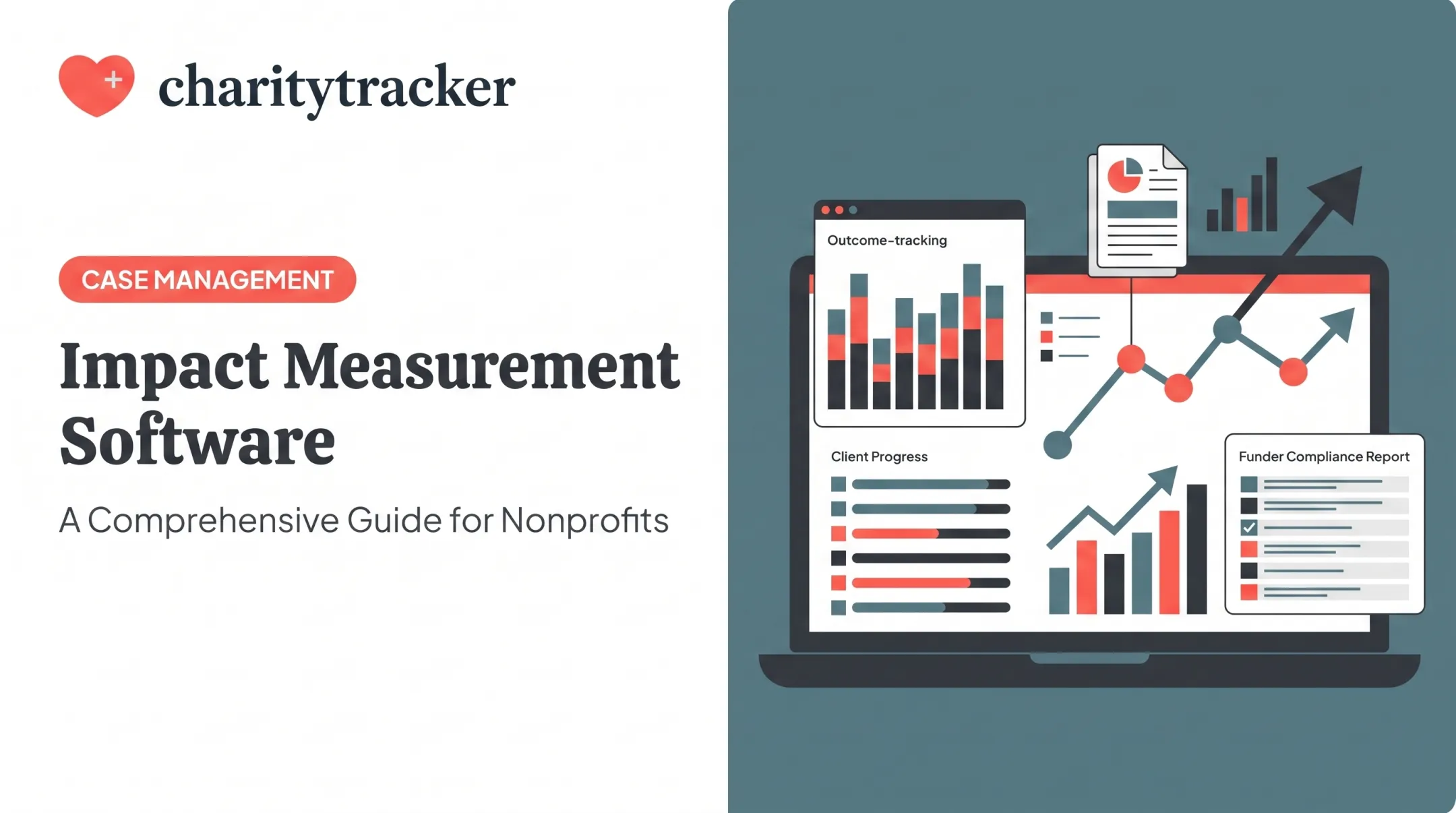
CharityTracker's Changes Over Time Report shows how this works in practice. It tracks individual clients and their goals using customizable assessments and measurement checkpoints, from initial intake through later milestones or program completion.
Instead of digging through old case files to answer "did this program work," staff get a longitudinal snapshot showing whether clients actually progressed.
Funder-ready reporting is where this pays off most directly. CharityTracker supports customizable funder and grant report types, including CSV/Excel exports. One executive director noted the platform makes it "easy to create meaningful, grant-specific reports for all of our various grantors."

Coordination Without Duplication
CharityTracker's inter-agency referral network gives partner organizations shared, real-time visibility into a client's assistance history. This has measurable effects:
- Housing and shelter organizations report reducing duplicated services by an average of 20%
- Remote intake lets clients complete forms digitally, 24/7, cutting manual re-entry
- One user, Nathaniel R., reported cutting paperwork time "in half, at least" after inter-agency coordination reduced redundant data entry
Trident United Way has used the platform for 12 years. Leadership credits it with helping agencies see client assistance histories, collaborate across organizations, and interrupt cycles of generational poverty.
Common Challenges and How to Overcome Them
Even with the right tools, measurement plans run into predictable snags.
Over-collecting data without a clear plan. Tracking everything is tempting but counterproductive. Pick a handful of vital metrics tied to your theory of change, and resist the urge to add "just one more field."
Inconsistent data entry across staff and locations. When five case workers enter data five different ways, your reports become unreliable. Standardized templates and a shared central database keep entries consistent. Built-in search, which CharityTracker users credit with fewer duplicate records, catches errors before they compound.
Funding and staffing constraints. Small nonprofits often can't afford a data analyst. Affordable, tiered software closes that gap. CharityTracker prices plans so teams can start lean and add measurement depth later:
- Basic Plan: $20/user/month for standard case intake
- Plus Plan: $40/user/month with outcome measurement and goal tracking
- Pro Plan: $60/user/month ($648/year with the annual discount), adding assessments, remote intake, and Changes Over Time Reports

Organizations can start small and grow into stronger measurement as budgets allow.
Frequently Asked Questions
What is impact measurement?
Impact measurement is the ongoing process of tracking real-life outcomes for the people a program serves, using both quantitative data (like housing status or employment rates) and qualitative data (like interviews). It goes beyond counting services delivered.
What is the difference between impact measurement and impact evaluation?
Impact measurement is continuous tracking built into daily program operations. Impact evaluation is a bounded, formal study, often conducted periodically, that digs deeper into causation and program design.
How often should nonprofits measure impact?
Measure at regular intervals—intake, mid-program, and exit—rather than waiting for an annual review. This lets staff spot problems and adjust programming in real time.
What is a theory of change and why does it matter for impact measurement?
A theory of change is the framework connecting your program's activities to its intended outcomes. It should be built before you choose KPIs, since it determines what's actually worth measuring.
What tools do organizations use to measure impact?
Common tools include surveys, structured interviews, case management software, and reporting dashboards. Case management platforms like CharityTracker centralize this data and generate funder-ready reports automatically.
How can small nonprofits measure impact with limited resources?
Focus on a few key metrics tied directly to program goals, and use affordable case management software instead of building custom spreadsheets. Start with basic tracking, then add features as your team’s capacity and reporting needs grow.