That gap between doing good work and proving it is where most nonprofits get stuck. Staff burnout and capacity constraints make measurement feel like an extra job on top of the real job — CEP's 2026 State of Nonprofits report found that roughly three-quarters of nonprofit leaders say staff burnout directly affects their organization's ability to achieve impact.
Program outcomes software exists to close that gap. It's a category of case management tools built to track not just what services you delivered, but what actually changed for the people you served — then turn that data into reports funders and boards can actually use.
This article covers what program outcomes really are, the common tracking mistakes that sabotage good programs, what to look for in software, and how platforms like CharityTracker put this into practice.
Key Takeaways
- Outcomes measure client change, not just service volume, and that distinction shapes every grant report you write
- Manual spreadsheet tracking creates silos, duplicate entry, and last-minute grant scrambles
- Prioritize software that centralizes records and supports configurable reporting plus inter-agency referrals
- SMART criteria and baseline data turn vague goals into measurable, fundable outcomes
What Are Program Outcomes and Why Do They Matter?
Program outcomes are the measurable changes or benefits that result from your work — not the count of people who walked through your door. That distinction trips up more organizations than you'd think.
Inputs, outputs, and outcomes are three different things:
- Inputs — the resources you use: staff, funding, curriculum, facilities
- Outputs — what you produced: meals served, classes held, families housed
- Outcomes — the actual change: a formerly homeless family maintains stable housing for 12 months, a job-seeker gets hired and keeps the job
Take a housing program. "We placed 40 families in housing" is an output. "32 of those families remained stably housed six months later" is an outcome. Funders increasingly want the second number, not just the first.

Why This Distinction Drives Better Decisions
Outcomes data does more than satisfy a grant report line item:
- Improves program design by showing which services produce measurable change
- Builds funder trust through evidence instead of anecdotes
- Informs internal decisions about where to expand or cut programs
- Meets grant requirements under 2 CFR 200.301, which can require indicators, targets, and baseline data—not just activity counts
The National Council of Nonprofits notes the sector has steadily shifted from counting outputs toward measuring genuine impact.
Every outcome you track should trace back to your mission. If your mission is breaking cycles of poverty, "families served" tells funders nothing about whether that's happening. "Families who achieved financial stability within 18 months" does.
Common Challenges Nonprofits Face When Tracking Outcomes
Most organizations want to measure outcomes. What they lack is the infrastructure. NTEN's 2026 survey of 220 nonprofits found manual data entry is still the dominant collection method, with almost 90% of organizations having staff type data in by hand.
The spreadsheet problem shows up in predictable ways:
- Data siloed by program, with no shared view of a client's full history
- Duplicate entry across intake forms, case notes, and funder spreadsheets
- Inconsistent metrics between programs, making agency-wide reporting nearly impossible
This isn't just inconvenient. It creates real risk. The same NTEN research found only about 11% of nonprofits produce standardized reports, while over 72% customize a report for every single funder. When grant deadlines hit, staff scramble to reconstruct a year of data by hand. The resulting "impact story" is often a rough approximation, not a real number.

There's also a coordination risk. Without shared client visibility across agencies, two organizations can unknowingly serve the same family and duplicate resources. A 2026 GAO review found that jurisdictions using automated data sharing helped caseworkers get client information faster and make better-informed decisions.
Key Features to Look For in Program Outcomes Software
Not every case management tool actually measures outcomes. Some just digitize a paper form. Here's what separates real outcomes software from a glorified spreadsheet:
| Feature | Why it matters |
|---|---|
| Outcome vs. output tracking | Measures actual change (behavior, status, knowledge), not just headcounts |
| Configurable funder reporting | Aligns with specific grant metrics without custom development |
| Centralized client data | One digital record across programs and locations, not five spreadsheets |
| Remote/mobile access | Caseworkers log outcomes and update records from the field |
| Data security & compliance | HIPAA-aligned protections for sensitive client information |
| Inter-agency collaboration | Shared referrals and case history prevent duplicate service delivery |

Why Configurable Reporting Beats Custom Reports
Most organizations customize reports for every funder, so your software needs a reusable measure layer under flexible report views. Otherwise you rebuild the wheel every grant cycle. That fragmentation is the problem outcomes software is supposed to solve.
Security Isn't Optional
If you're handling health, housing, or domestic violence case data, HIPAA's Security Rule requires administrative, physical, and technical safeguards for anyone who qualifies as a covered entity or business associate.
Ask vendors what specific controls they have (encryption, access governance, backups) rather than accepting "HIPAA compliant" as a label.
How CharityTracker Helps Nonprofits Improve Program Outcomes
CharityTracker was built by Simon Solutions in 2026 during Hurricane Katrina relief coordination. That origin still shapes the product: teams can track client progress in one place and show funders what changed.
Here’s how it supports stronger program outcomes:
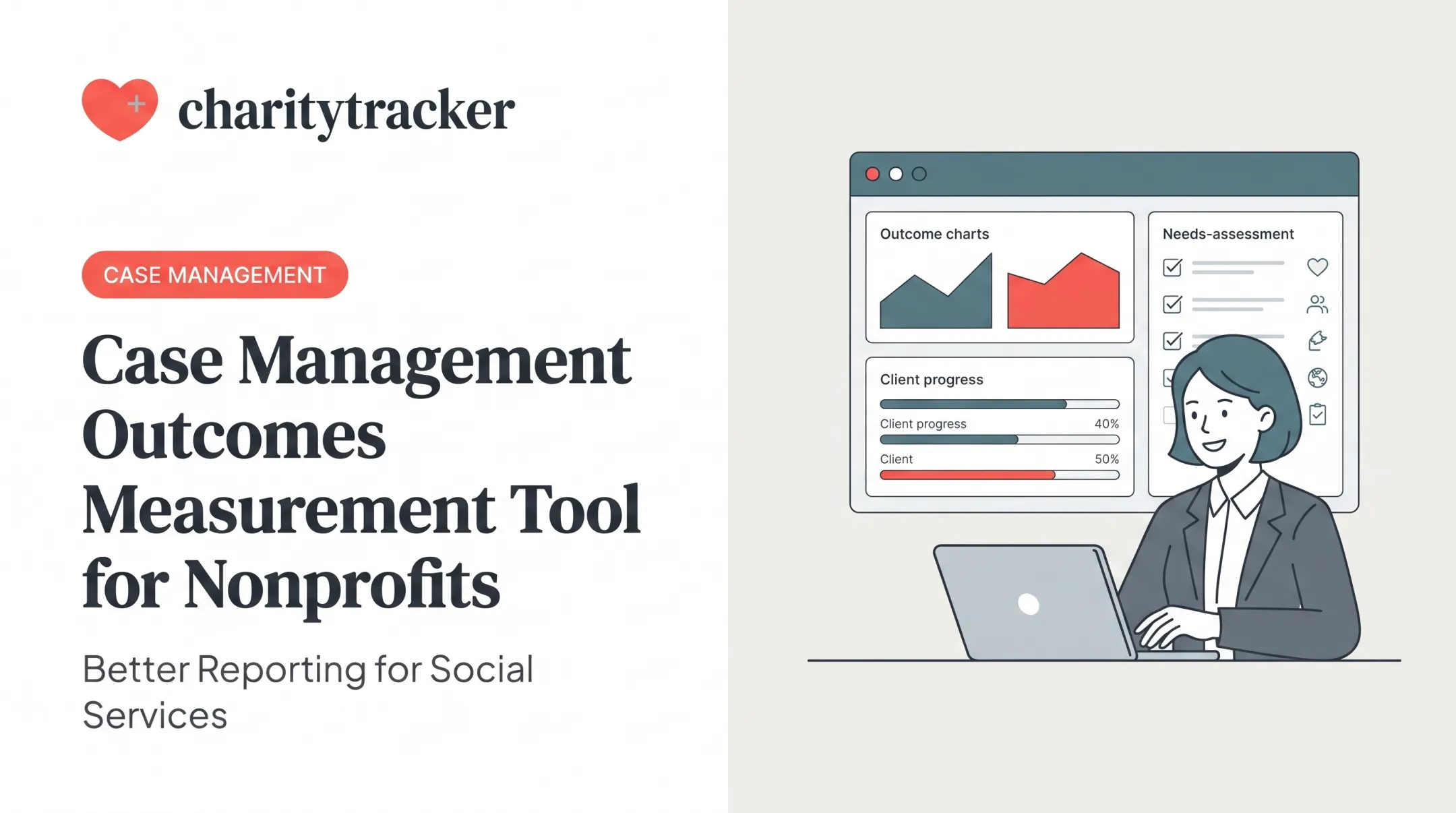
- Give every client one digital record, with customizable assessments, goal follow-up dates, and a Changes Over Time Report from intake through milestones and completion—no more separate spreadsheets per program
- Coordinate referrals in real time so authorized partner staff can see relevant service history (with client consent and a Release of Information on file) and stop duplicate emergency assistance
- Produce funder-ready VOCA, ESG CAPER, APR, System Performance Measures, and HMIS/AHAR reports; Nathaniel R., a First Call for Help representative, cut paperwork time "in half, at least" because the tools are "so user-friendly"
- Start fast with a 14-day free trial, registration in minutes, account confirmation in about 5–10 minutes, and no onboarding fee
- Use remote and kiosk intake on a platform available 24/7/365 when disaster response teams need to mobilize outside office hours
Organizations across the country use CharityTracker, including The Salvation Army and Boys & Girls Clubs of America, in a network of more than 2,500 communities and 20,000-plus users.
Best Practices for Measuring and Reporting Program Outcomes
Good software doesn't fix bad metrics. Before you configure a single report, get your outcome definitions right.
Use SMART criteria. The CDC's evaluation guidance recommends objectives that are Specific, Measurable, Achievable, Relevant, and Time-bound. "Improve financial stability" isn't measurable. "80% of participants increase savings by $500 within six months" is.
Collect baseline data first. You can't measure change without knowing the starting point. Federal performance guidance lists baseline data among the elements grant recipients may need to report. Collect it before the program starts, not after.
Involve frontline staff in metric design. Caseworkers know which indicators are realistic to collect and which ones actually reflect client needs. Skipping this step produces metrics that look good on paper but nobody can consistently gather.
Report on a fixed cadence. Set a schedule your board and funders can count on—monthly snapshots for internal teams, quarterly or grant-cycle reports for external audiences. Consistent timing beats one-off data dumps when renewal decisions arrive.
Close the loop with the data. Share wins and shortfalls with program staff, then adjust services, targets, or intake questions. Outcome reports should drive better delivery, not sit in a folder after submission.

Clear definitions, honest baselines, and steady reporting turn outcome data into proof of impact—and a map for what to improve next.
Frequently Asked Questions
What is the best software for nonprofits?
It depends on your size and needs. Affordable case management CRMs like CharityTracker work well for outcome tracking and cross-agency collaboration, with plans starting at $60 per month and a free trial available.
What's the difference between an output and an outcome?
Outputs are the quantity of services delivered, such as meals served or classes held. Outcomes are the resulting change in a client's life or status, like improved housing stability or employment.
How often should nonprofits measure program outcomes?
Most organizations measure at regular intervals, such as quarterly, alongside baseline measurements at intake and exit measurements at program completion, timed to align with grant reporting cycles.
Can small nonprofits afford outcomes tracking software?
Yes. Purpose-built platforms exist for organizations with limited budgets and staff. CharityTracker's Pro Plan starts at $60 per month, and a free trial is available.
How does outcomes software help with grant reporting?
It consolidates scattered data into one system and generates funder-ready reports automatically, saving the hours normally spent rebuilding spreadsheets before every deadline.
Why do funders require outcome data instead of just output data?
Funders want evidence of actual change to justify continued investment, not just proof of activity volume. Output counts show effort; outcome data shows results.