Introduction
A client walks into your office needing housing help, but your program only handles food assistance. Now what?
The case management referral process is how you connect that client to an internal program, outside organization, or specialized service that can meet the need.
This guide is for case managers, social workers, nonprofit and human services teams, healthcare and government agencies, faith-based ministries, and community organizations across the United States.
Without a clear referral path, clients fall through cracks, staff duplicate work, and no one owns follow-up. A consistent process protects continuity of care, service matching, privacy, and accountability.
Referral forms matter, but they are only one piece of the workflow—not the whole process. This guide covers:
- How the referral process works end to end
- What belongs on the referral form
- What drives approval, tracking, and follow-up
- When a referral is the wrong move
Key Takeaways
- Follow one path: identify need, select provider, get consent, submit, confirm acceptance, and document.
- Complete forms give providers eligibility-ready detail and cut clarification delays.
- Approval timing varies with urgency, eligibility, documentation, and provider capacity.
- Secure sharing and documented follow-up prevent lost referrals, duplicates, and support gaps.
What Is the Case Management Referral Process and Why Is It Used?
The referral process is the entire workflow: identifying a need, matching a client to a service, getting consent, submitting information, and confirming what happened next. The referral form is just one tool inside that workflow — a way to communicate the client's situation and request service.
The goal is straightforward: connect the right client to the right service while preserving continuity of care, informed consent, accurate records, and clear ownership of next steps.
Why organizations rely on referrals:
- The need falls outside the referring team's scope (housing, food, healthcare, behavioral health, employment, transportation)
- Specialized eligibility requirements apply that only certain providers can evaluate
- Geographic, language, or cultural needs require a different provider
- The situation involves crisis support requiring immediate specialized intervention
The National Association of Social Workers describes case management as planning, seeking, advocating for, and monitoring services across organizations on a client's behalf. Each referral should include ongoing assessment and a documented rationale, according to NASW's Standards for Social Work Case Management.
Without a defined process, things break down fast:
- Incomplete information reaches the receiving provider
- Referrals go to organizations that can't actually help
- Clients get duplicate assistance from multiple agencies
- Responses get delayed, and nobody owns the follow-up
- No reliable record shows whether the client ever received help
Referral procedures also aren't purely internal preference. Organizational policy, funder requirements, program eligibility rules, and privacy obligations all shape how a specific agency's referrals must work. Check your program's funding and regulatory requirements rather than assuming one rule fits every program.
How the Case Management Referral Process Works
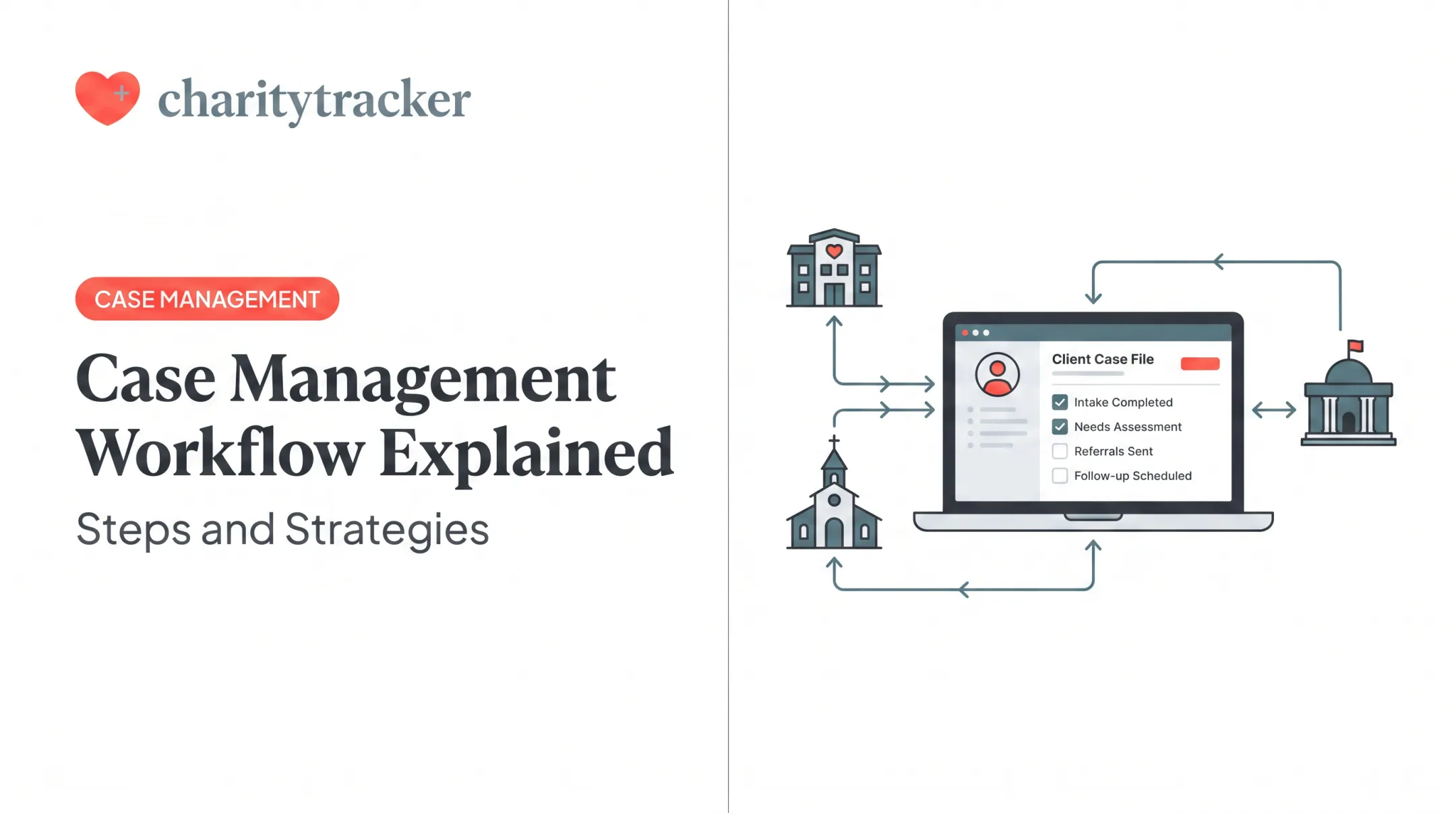
Most referral workflows move through five stages: assess the need, choose a destination, get consent and complete the form, submit and confirm status, then coordinate delivery and follow up. Here is how each stage works in practice.

Step 1: Identify and Assess the Client's Need
Start by gathering only the information relevant to the referral itself. That means determining:
- How urgent the situation is
- What barriers the client faces (transportation, documentation, language)
- Whether the need falls inside or outside your organization's services
Collect only what the referral requires. Extra personal detail the receiving provider does not need adds privacy risk without improving the handoff.
Step 2: Select the Appropriate Referral Destination
Match the client to a provider based on service type, eligibility, and practical fit. Consider:
- Availability and current capacity (including waitlists)
- Accessibility: physical location or remote/virtual access
- Language and cultural considerations
- Any immediate safety or crisis concerns that change the urgency calculus
A referral to a technically-correct service that the client can't physically reach or communicate with isn't actually a good referral.
Step 3: Obtain Consent and Complete the Referral Form
This is where most referral breakdowns start. A complete form typically includes:
- Client name or an approved identifier
- Contact information and preferred contact method
- Presenting need, described objectively
- Requested service and urgency level
- Eligibility details and relevant history
- Supporting documents
- Referring staff member and receiving organization
- Consent or release information
- Requested follow-up timeframe
Required fields vary by program, so check the receiving provider's intake requirements before you submit. Then:
- Use plain, objective language
- Separate what you observed from what you are assuming
- Verify dates and contact details
- Share only the minimum information the receiving provider needs to act
Step 4: Submit, Confirm Receipt, and Determine Approval
Submission should happen through a secure channel, not an unencrypted email or a paper form left on a desk. Once submitted, the receiving organization typically moves through triage, eligibility review, and a decision: accept, reject, waitlist, or request missing information.
HUD's coordinated entry guidance describes receiving agencies recording referral status as accepted, pending, or rejected, including documented reasons for rejection, according to HUD's Coordinated Entry Management and Data Guide. That kind of status tracking matters — an "unknown" referral status is functionally the same as a lost referral.
Disconnected paper forms and scattered email threads make that status easy to lose. Digital case management software such as CharityTracker centralizes intake, referral records, status updates, client history, and inter-agency coordination.
A case manager can then see whether a referral was accepted, not only whether it was sent.
Step 5: Coordinate Service Delivery and Follow Up
Submitting a form is not the same as the client getting help. The referring organization still owns:
- Confirming whether the client actually connected with the receiving provider
- Recording service outcomes or barriers encountered
- Updating the case plan based on what happened
- Making another referral if the original service falls through
Referral submission, referral acceptance, actual service delivery, and eventual case closure are four distinct events. Treating "I sent the form" as "the client is taken care of" is one of the most common and most damaging assumptions in case management.
Where Referrals Are Applied and What Affects Them
Referrals appear across human services settings, including:
- Nonprofit programs and faith-based ministries
- Healthcare and behavioral health settings
- Government benefits offices
- Housing, homelessness, and food assistance
- Youth, veteran, and disaster relief programs
- Cross-agency community networks
Within a client's journey, referrals typically occur during:
- Intake and initial assessment
- Case planning
- Crisis response
- Recurring service coordination
- Reassessment and transition planning
- Case closure
Three Referral Types
| Type | Who initiates | Who receives |
|---|---|---|
| Internal | Case manager within the organization | A different program in the same agency |
| External | Case manager | A separate outside organization |
| Self or community | Client, family member, or community contact | Any agency that can screen the request |
A self-initiated inquiry can later become either an internal or external referral. The origin and destination are two separate things.
What Affects Referral Success
Approval and speed hinge on several variables at once:
- Completeness of the submitted form
- Documented client consent
- Eligibility fit and required documentation
- Urgency of the need
- Provider capacity and any active waitlist
- Funding restrictions tied to the receiving program
- Communication preferences and response time
Technology can improve visibility across this whole picture. Remote intake, digital signature capture, centralized records, status tracking, and a built-in inter-agency network like CharityTracker's help organizations see referral activity across partners in real time. That said, software supports professional judgment and consent procedures; it doesn't replace them.

Common Issues, Misconceptions, and When a Referral May Not Be Appropriate
Frequent mistakes worth watching for:
- Submitting incomplete or outdated client information
- Using vague descriptions of the actual need
- Sending a referral before obtaining consent
- Failing to confirm the receiving provider got it
- Referring to a provider that can't actually serve the client
- Creating duplicate referrals across agencies
- Closing the task without documenting what happened
Three misconceptions to correct immediately:
- A referral does not guarantee service — acceptance and delivery are separate steps.
- There's no fixed universal approval timeframe — it depends entirely on the program.
- The referring organization's responsibility doesn't end when the form is sent.
When a referral may not be the right call:
- The need can be resolved internally without involving another agency
- The client hasn't agreed to the referral
- The receiving service is clearly ineligible or unavailable
- The situation calls for emergency intervention, not a routine handoff
- A direct warm handoff would be faster and safer than a form-based process
Stricter confidentiality rules still apply:
Certain information categories carry stricter rules than a general release. Alcohol or drug abuse treatment records generally cannot be disclosed without the client's express written consent under federal confidentiality protections. A general medical authorization isn't enough on its own.
State mental health laws often impose similar restrictions on identifying someone as a facility client. When in doubt, follow local emergency and safeguarding protocols rather than defaulting to a standard referral form.

Conclusion
An effective case management referral process is more than a completed form. It connects the full chain:
- Assessment and consent
- Accurate documentation and provider matching
- Secure submission and approval
- Follow-up and outcome tracking
The form supports communication with the client and the receiving organization; it doesn't replace it. Timelines and required information vary by program, funder, and jurisdiction, so confirm those specifics before assuming a standard timeframe applies.
Clear ownership, minimum-necessary information sharing, documented follow-up, and appropriate escalation are what get clients to the services they need. Deliberate application beats automatic referral. Coordinated case management tools can keep that ownership and follow-up visible across agencies, but process discipline still comes first.
Frequently Asked Questions
How do I fill out the referral form?
Verify the client's information, describe the need objectively, and identify the requested service and urgency level. Document consent, attach required supporting records, and submit through your organization's approved secure channel.
What are the steps of the referral process?
Typical steps are: identify the need, select a provider, obtain consent, complete the form, submit securely, confirm receipt, coordinate delivery, follow up, and document the outcome.
How long does it usually take for a referral to be approved?
Timing varies by program based on urgency, eligibility review, documentation completeness, provider capacity, and waitlists. Confirm the expected timeframe with the receiving organization instead of assuming a standard window.
What should be included in a referral form?
Include client identifiers, contact details, presenting need, requested service, urgency, eligibility information, relevant history, consent documentation, supporting records, referring-party details, and follow-up preferences.
What are the five steps in the case management process?
Most frameworks use five stages: screening and assessment, collaborative planning, implementation and coordination (including referrals), monitoring and follow-up, and evaluation or closure. Labels vary by organization.
What are the three types of referrals?
Internal referrals move a client between programs within the same organization. External referrals send a client to a different agency. Client-, family-, or community-initiated referrals come from the person seeking help or someone connected to them.